
How corporate development teams build a scalable deal origination engine
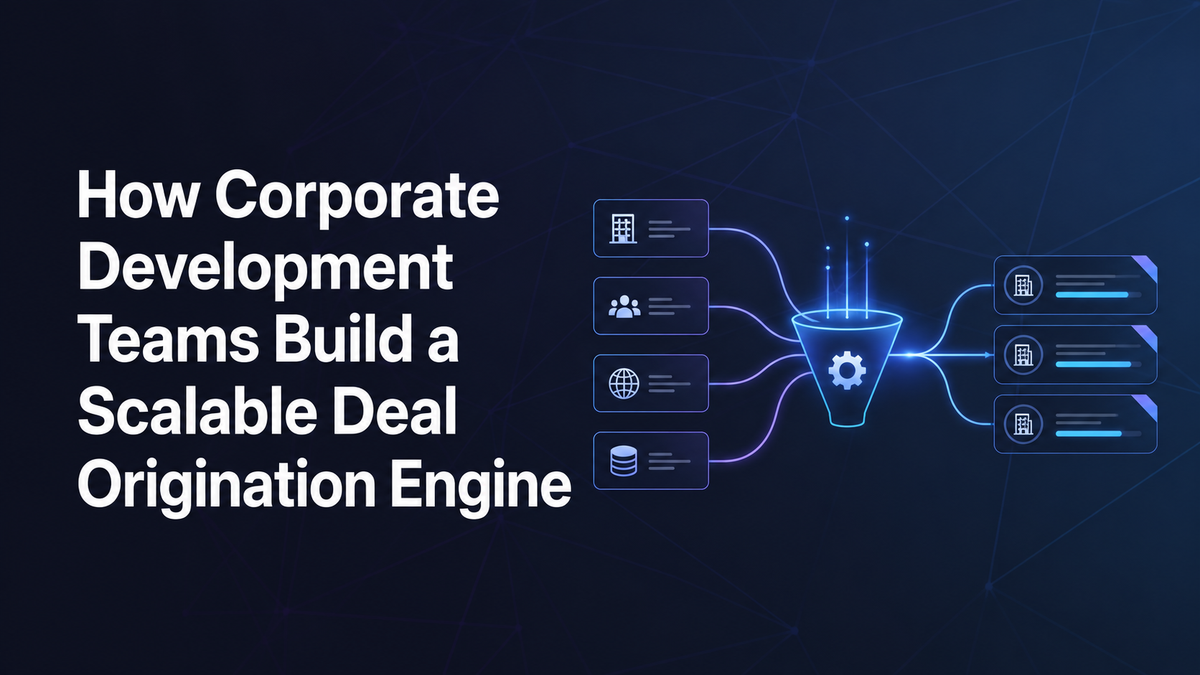
Most M&A teams have a sourcing problem they do not fully acknowledge. Deal flow exists, but it is not systematic. Targets surface through networks, referrals, and occasional database searches. Good opportunities get missed, not because the team is not capable, but because the process is not built to find them consistently.
Building a scalable origination engine is about changing that. Here is how high-performing mid-market PE and corporate development teams do it.
Start with a clear search thesis, not a broad mandate
The teams that source well are specific about what they are looking for. Not "industrial businesses in the DACH region" but a defined business model profile: revenue range, ownership type, geographic footprint, customer structure, margin profile.
A clear search thesis does two things. It makes systematic screening possible. And it forces the internal conversation about what actually fits strategically before a target lands on the table.
Without it, origination stays reactive.
Build longlists systematically, not manually
This is where most corp dev teams lose the most time. A junior analyst spends a week pulling names from databases, cross-referencing industry codes, and building a spreadsheet that a senior manager then cuts in half based on memory and instinct.
The problem is not the analyst. It is the method. Industry codes are too broad. Manual web research misses private companies with no SEO presence. And the result is a list shaped more by visibility than by actual strategic fit.
Purpose-built platforms solve this differently. StrategyBridgeAI searches across around 50 million private and public companies via a semantic chat interface: describe the business model, market position, ownership type, and size you are looking for, and the platform generates a structured longlist based on actual company characteristics, not keyword matches or sector codes.
Hard filters sit alongside the semantic search, allowing teams to screen by financial KPIs, ownership structure, geography, and transaction history. The output exports directly to Excel with financials, ownership data, qualitative company information, and contact details included.
The difference in practice is significant. Nikolai Üstündag of WTS Advisory puts it plainly:
"For longlists, we used to spend two or three weeks. Now we get it done in two or three afternoons. For multiple valuations, we are at 85 to 90 percent time savings."
Dr. Dirk Pramann of Mition Mittelstandsbeteiligungen describes the shift in how sourcing actually feels:
"Longlisting is where we get the most value. We now work systematically rather than subjectively, and significantly faster."
And one M&A team at a large international services group noted after running their first search:
"The volume of results was genuinely satisfying, and there were many companies in there we had never heard of before."
That last point matters more than it sounds. The best targets in the mid-market are often the ones no one else has found yet.
Do a first-view analysis before you make calls
Experienced corp dev teams know the problem: you reach out to a target, the conversation goes well, and two weeks later you realise the business does not match the financial profile you assumed. That wastes time on both sides and damages credibility.
A structured first view before outreach changes this. StrategyBridgeAI's Company Snapshot delivers exactly that in under 60 seconds: a management summary, key financials, ownership structure, strong points, watch-outs, disruption risks, and right-to-win assessment, and more, pulled from verified sources and ready to use immediately. No manual research, no switching between tools.
When a target passes that first filter, the same workflow takes it further without any additional setup. The full outside-in business analysis module covers everything needed for a deeper assessment or red-flag due diligence: benchmarking against structural peers, deterministically calculated valuation, market analysis, and forecasting grounded in market data. All of it calculated deterministically, analytically interpreted, and delivered as a board-ready output directly in the client's own PowerPoint design.
One workflow, from first screening to investment decision. Nothing to copy, reformat, or rebuild.
Make outreach informed, not generic
The teams that get response rates in cold outreach are the ones who know something specific about the company they are contacting. A reference to a market position, a recent transaction, or a competitive dynamic. That requires having done the analysis before making contact.
The origination engine only works if the full sequence holds together: search thesis, systematic longlist, outside-in analysis, informed outreach. Each step feeds the next. And each step is faster and more consistent when the underlying data infrastructure is built for the job.
What separates the teams that source well
It is not access to more databases. Most teams already have access to enough data. What separates high-performing origination is the ability to move from a search idea to a qualified target list to a first-view analysis quickly, consistently, and without depending on heroic manual effort from the team.
That is what a scalable origination engine looks like in practice.
See how StrategyBridgeAI supports deal origination end to end.
More from this category
Explore related insights from StrategyBridgeAI.

How to source add-on acquisition targets for a buy-and-build strategy
Add-ons are now the default deal in European private equity. Here is how to build an add-on pipeline that covers the whole target universe, not just the part already for sale.

How to source add-on acquisitions for a buy-and-build strategy
Add-on sourcing fails when the target universe is too small, not when the process is too slow. A practical method for building a buy-and-build pipeline that holds.

How to build a buyer list for a sell-side M&A process
In a sell-side process, the buyer list sets the ceiling on price. A practical method for building, tiering and defending a buyer list, and the candidates most lists quietly miss.