
M&A software with AI integration: what to look for and how leading teams use it
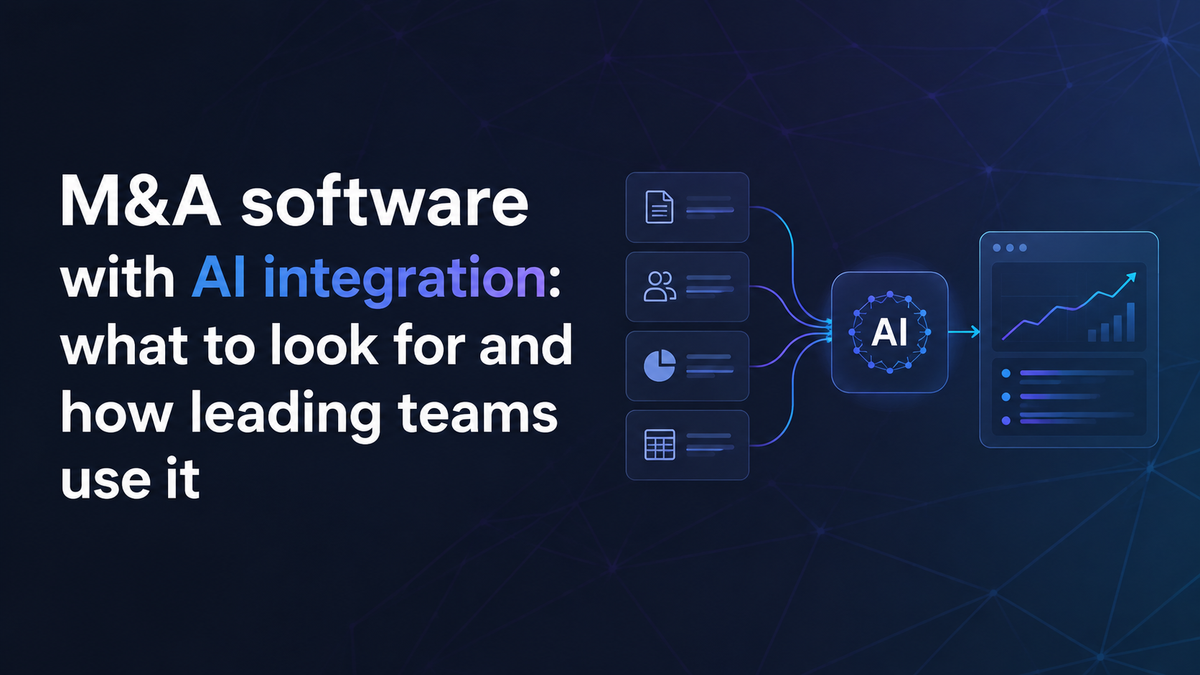
Most M&A software vendors now market some form of AI integration. The category has expanded fast, and the term covers everything from a GPT-powered search bar to a fully integrated analysis platform built on verified company data.
For deal teams trying to evaluate what is actually useful, the noise is real. This is a practical breakdown of what AI integration in M&A software should deliver, what the gaps typically are, and how purpose-built platforms differ from generic tools with AI features bolted on.
What AI integration in M&A software actually means
The term is broad enough to cover almost anything. In practice, AI integration in M&A software tends to fall into three distinct levels:
Surface-level AI features. Natural language search, auto-generated summaries, chatbot interfaces layered over existing databases. Fast to ship, easy to demo, but the underlying data and analytical methodology remain unchanged.
AI-assisted workflows. Automation of specific steps in the deal process: drafting, document review, data extraction from filings. Useful, but typically point solutions that do not address the core analytical work.
AI-integrated analysis platforms. Purpose-built systems where AI drives the core analytical logic: target identification, peer group selection, benchmarking, valuation, and market analysis, all from a consistent, verified data foundation. This is where the real productivity and quality gains come from.
The difference between these levels is not visible in a product brochure. It shows up when a team runs a real workflow and asks: where did this number come from, and would it hold up in an IC presentation?
The five capabilities that matter for M&A teams
1. Target and buyer identification at scale
Manual longlist creation is one of the highest time costs in any deal process. AI-driven target and buyer identification should search across private and public companies using business model logic, not just keyword filters or sector codes.
The limitation of most database-based tools is that they find what is already labelled. Niche companies, private mid-market businesses with limited online presence, and businesses that span multiple sector classifications all get missed.
StrategyBridgeAI's Longlist module searches across around 50 million private and public companies via a semantic chat interface. The search is driven by business model description, ownership type, geography, financial profile, and strategic fit, not by the sector code the company happens to be filed under. Results are filterable by financial KPIs, ownership structure, and transaction history, and export directly to Excel with full data coverage including financials, ownership, qualitative company data, and contact details.
"Longlisting provides us with the greatest added value. We now work systematically rather than subjectively, and much faster."
Dr. Dirk Pramann, Managing Partner, Mition Mittelstandsbeteiligungen
2. Outside-in company analysis on demand
Getting a credible outside-in view of a target company, including its competitive position, financial benchmarks, and valuation range, used to mean days of analyst work. That is the workflow AI integration should compress most aggressively.
StrategyBridgeAI's Hawk Eye module delivers a full outside-in company assessment at the click of a button. What used to require 20 to 80 hours of manual is now much more efficient. The output covers:
- Competitors and peers identified by structural business model similarity, not sector codes
- Benchmarking of margins, growth rates, capital efficiency, and other KPIs against direct peers and the broader sector
- Sector and market analysis covering dynamics, trends, entry barriers, and value chain
- Valuation calculated deterministically using established financial methodologies, including multiples, WACC, and more.
- Forecasting grounded in peer trends and market data
Every output is traceable to a verified source. Every report is delivered in the client's own PowerPoint design, board-ready without manual reformatting.
"Analyses are now available faster and at the same time much more comprehensive than before."
Tobias Nellinger, dhmp
3. Reproducible, deterministic output
This is the capability most AI-integrated M&A tools do not have. General-purpose AI tools are stochastic: the same input produces a different output each time. For analysis that ends up in front of an investment committee, a board, or an auditor, that is not acceptable.
StrategyBridgeAI produces deterministic output. Ten identical inputs produce ten identical outputs. The analysis is reproducible, shareable internally, and consistent across team members and time. That reproducibility is also what makes the output defensible when challenged.
4. Data quality and source transparency
AI output is only as good as the data it draws from. M&A software with AI integration needs to answer a simple question: where does this number come from?
StrategyBridgeAI pulls from verified primary sources including company registries, trade associations, deal databases, sector publications, and AI-supported web intelligence. Sources are classified by quality tier and validated before use. Every data point in every output links back to a specific, traceable source. This is the foundation of audit-grade analysis, and it is what distinguishes purpose-built M&A software from generic AI tools with a data layer underneath.
5. GDPR-compliant infrastructure
Uploading deal-sensitive company and counterparty data to a generic AI tool raises real compliance questions. For professional deal teams, this is not theoretical.
StrategyBridgeAI is hosted on European servers within the EWR, primarily in Germany, and processes data in accordance with DSGVO/GDPR. Client data is logically separated from the platform's public data foundation and is not used for model training. The platform is listed by the Institut der Wirtschaftsprüfer (IDW) and used by more than 150 clients across M&A advisory, corporate finance, audit, and banking.
How M&A teams use AI-integrated software in practice
The most effective use of AI-integrated M&A software is not as a replacement for analyst judgment. It is as the infrastructure that removes the low-value steps so analysts can spend their time on the work that actually requires judgment.
A typical workflow with StrategyBridgeAI looks like this:
Market screening and white space identification. Structured screening of markets, segments, and adjacent business models from a single platform, before a target has even been identified.
Target and buyer lists. Semantic search across 50 million companies produces a logic-based longlist in minutes. The list includes private companies and niche players that do not surface in traditional database searches.
First-view company assessment. The Company Snapshot delivers key financials, ownership, sector context, and a management summary in under 60 seconds. For screening decisions, that is often enough to qualify or disqualify a target before investing more time.
Full outside-in analysis. For targets that pass the initial screen, the Hawk Eye produces a complete competitive, financial, and valuation analysis. The output is presentation-ready and client-facing from the start.
Pitch and IC preparation. Reports are delivered directly in the client's or advisor's own design. Less reformatting, more time on the analysis itself.
"We are now working with higher quality and significantly less time investment."
Holger Danowsky, Co-Founder
Frequently asked questions: M&A software with AI integration
What is the best M&A software with AI integration?
The right tool depends on the specific workflow. For target identification, peer benchmarking, outside-in company analysis, and valuation, StrategyBridgeAI covers the full deal cycle from a single platform, with deterministic output, verified data, and GDPR-compliant infrastructure. It is used by M&A advisors, corporate development teams, private equity, audit firms, and banks across Europe.
How does AI improve M&A target screening?
AI-driven target screening replaces keyword-based database searches with semantic search based on business model logic, financial profile, ownership type, and strategic fit. This surfaces private companies and niche players that traditional database tools miss, and produces structured longlists in minutes rather than days.
What does deterministic output mean in M&A software?
Deterministic output means that identical inputs always produce identical outputs. Unlike general-purpose AI tools that produce stochastic results, a deterministic platform ensures reproducibility, which is a baseline requirement for IC materials, audit documentation, and any analysis that needs to be defended after the fact.
Is AI-integrated M&A software GDPR-compliant?
It depends on the platform. Generic AI tools raise real compliance concerns when handling deal-sensitive data. StrategyBridgeAI is hosted on European servers in Germany, processes data under DSGVO/GDPR, and does not share client data with third parties or use it for model training.
How much time does AI-integrated M&A software save?
Users of StrategyBridgeAI report time savings of more than 80 percent on analysis tasks that previously required 20 to 80 hours of manual work. For longlist creation specifically, teams report reducing the process from two to three weeks to two to three afternoons.
More from this category
Explore related insights from StrategyBridgeAI.
StrategyBridgeAI vs. Grata: platform comparison for M&A
Grata fills the pipeline. StrategyBridgeAI searches more companies, delivers more mid-market depth and carries through to a defensible valuation. The comparison.
StrategyBridgeAI vs. Rogo: platform comparison for M&A
Rogo automates documents on data a firm already licenses. StrategyBridgeAI brings the mid-market data itself, plus analysis and valuation. The comparison.
StrategyBridgeAI vs. Inven: deal sourcing compared
StrategyBridgeAI vs. Inven: a larger search universe, sharper financial and ownership filters, and analysis through to valuation. Why StrategyBridgeAI comes out ahead.