
Why on-demand market analysis is replacing static industry reports
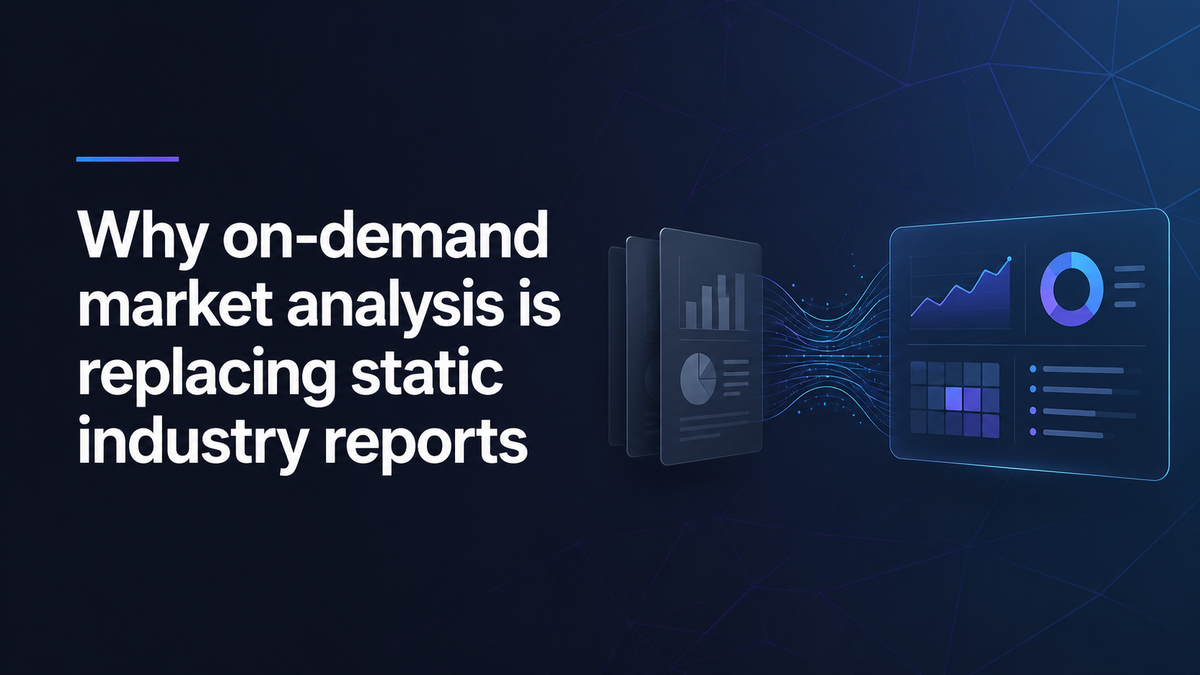
Industry reports have been a staple of business analysis for decades. But the way markets move today, and the decisions that depend on understanding them, has outpaced what a static, periodically updated report can reliably deliver.
Three structural limitations keep coming up in practice. Here is what they are, and what a different approach looks like.
The data is already old when you use it
Most standard industry reports are based on data that is 6 to 12 months old at the point of publication. By the time a team pulls the report for a project, the underlying numbers may be 18 months stale or more.
In stable sectors that moves slowly, that lag is often acceptable. In markets where competitive dynamics, margin profiles, or growth rates are shifting, it creates a meaningful gap between the analysis and the reality it is supposed to represent.
StrategyBridgeAI generates market analysis on demand, from live data sources at the point of query. The market view reflects current conditions, not a publication cycle. Where a historical reference point is needed, point-in-time analysis is also available, with full transparency on the underlying data basis.
Rigid sector codes do not reflect how businesses actually operate
Standard industry reports are structured around classification systems: broad sector codes that sort companies into predefined buckets. That works when the subject fits cleanly into one category. It breaks down when the business model is more specific: a manufacturer with a software product, a services firm operating across multiple verticals, a niche supplier serving one end market within a broader sector.
The result is analysis that describes a sector the company technically belongs to, but not the market it actually competes in.
StrategyBridgeAI analyses markets along the dimensions that are relevant to the question: geography, product focus, customer type, market segment, business model. Standard classification codes (WZ, NACE, SIC, GICS) are fully supported where useful. But the analysis is not constrained by them. The output describes the actual competitive environment, not the nearest available approximation.
Limited source coverage creates gaps where it matters most
Many standard reports draw from a small set of statistical providers. For large, well-documented sectors in major markets, that coverage is often sufficient. For niche segments, private-company-heavy markets, or less-covered geographies, the gaps are significant.
StrategyBridgeAI pulls from a substantially broader source base:
- Company registries across multiple jurisdictions
- Trade associations and sector bodies
- Deal databases and transaction records
- Job portals as a real-time signal for company activity and growth
- Industry studies and research publications
- Company websites and press releases
- AI-supported web crawls for current market intelligence
The combination produces analysis that covers niche markets, private company landscapes, and cross-border segments that standard reports either aggregate out of view or do not cover at all.
What on-demand market analysis means in practice
The shift is from pulling a report that was written for a general audience to generating analysis that is built for the specific question at hand.
That means defining the market by the criteria that matter: not the broadest sector code that applies, but the geographic scope, the product category, the customer type, the revenue range of relevant players. The analysis then reflects the actual competitive set, drawn from current sources, with visible methodology and traceable data points.
For teams that need to present market context to a leadership team, an investment committee, or an external counterparty, that difference shows up directly in the quality of the conversation. Numbers that can be traced to a source hold up under scrutiny. Analysis built on a current data pull reflects the market as it is, not as it was described 12 months ago.
Frequently asked questions: market analysis and industry reports
What are the limitations of standard industry reports?
The main limitations are data recency (typically 6 to 12 months old at publication), rigid sector classification that does not reflect nuanced business models, and source coverage concentrated in a small number of statistical providers. For decisions that depend on current, precise market intelligence, these limitations create real gaps.
What is on-demand market analysis?
On-demand market analysis is generated at the point of query from live data sources, rather than published on a fixed schedule. It can be structured around the specific market definition relevant to the question, rather than a standardised sector code. StrategyBridgeAI provides this for corporate finance, advisory, audit, and strategic planning teams.
How does StrategyBridgeAI approach market analysis differently?
StrategyBridgeAI generates market and industry analysis from a broad, multi-source data foundation including company registries, deal databases, trade associations, job portals, and AI-supported web intelligence. Analysis is structured around deal-relevant or strategy-relevant market definitions rather than fixed classification codes, and every output includes source documentation.
Can StrategyBridgeAI replace standard industry reports?
For teams that need current, niche-precise, and source-transparent market analysis, StrategyBridgeAI delivers what standard reports cannot: real-time data, flexible market definition, and coverage of private-company-heavy or niche segments. Standard sector codes are also supported where relevant, so the two approaches can complement each other depending on the use case.
Is StrategyBridgeAI market analysis GDPR-compliant?
Yes. The platform is hosted on German servers, applies strict data separation, and does not share user data with third parties. It is recommended by the Institut der Wirtschaftsprüfer (IDW) and used by more than 150 clients across corporate finance, audit, and advisory.
The fundamental shift is from analysis built around what data providers have published to analysis built around the question that actually needs answering. For teams making consequential decisions on market position, competitive dynamics, or sector outlook, that distinction is worth taking seriously.
See how StrategyBridgeAI generates market and industry analysis.
More from this category
Explore related insights from StrategyBridgeAI.
How to estimate a private company's market share without public data
A practical, bottom-up method for estimating market share when a company doesn't disclose revenue: proxy indicators, sizing the addressable market, and validation checks.

Adjacent market analysis: how to decide which market to grow into next
A practical framework for corporate development teams: map adjacent markets, score them against your right to win, and turn the winning one into an acquisition longlist.

How to size a niche market when there is no analyst report
Analyst reports stop where real deals start. Here is the bottom-up, company-level method deal teams use to size a niche market and defend the number in the IC.