
Company valuation tools: what professional advisors and analysts actually need
Valuation comes up across a wide range of professional contexts. A business valuation for a succession transaction. A fairness opinion supporting a shareholder decision. A benchmark for a tax dispute. An indicative range for a restructuring plan. A going-concern assessment in an audit.
The common thread is that the output needs to hold up. Not just internally, but in front of clients, tax authorities, and professional oversight bodies. That requirement changes what a valuation tool actually needs to deliver.
The core problem with how valuation gets done today
Most valuation work still relies on a combination of manual peer research, data pulled from general-purpose sources, and analyst judgment applied at each step. The process is time-consuming, variable, and difficult to reproduce exactly.
Two specific problems come up consistently in professional practice.
Peer selection is inconsistent. The quality of a multiples-based valuation depends almost entirely on whether the peer group reflects the company being valued. When peers are selected manually, using sector codes or keyword searches, the results vary by analyst and by the data sources available at the time. Two qualified professionals applying the same methodology can arrive at meaningfully different peer groups, and therefore different valuation ranges, for the same company.
Data is hard to trace. For professional opinions that carry liability, every number in the valuation needs a source. Generic research tools, aggregated sources, and general-purpose AI tools do not provide source citation at the data point level. That makes the output difficult to document and difficult to defend.
What a professional-grade valuation tool needs to cover
Peer identification that reflects actual business model similarity
The starting point for any multiples-based valuation is finding the right comparables. Sector codes are the standard proxy, but they are a blunt instrument. A sector code designed for statistical classification can group companies with fundamentally different business models, cost structures, and margin profiles under the same label.
StrategyBridgeAI's Hawk Eye identifies peers using semantic analysis of business model characteristics across a universe of around 50 million private and public companies globally. The peer group is based on structural similarity: what the company does, how it earns revenue, who its customers are, and how it competes. Standard classification codes (NACE, SIC, GICS) are supported where relevant, but the analysis is not constrained by them.
For niche businesses, family-owned mid-market companies, and cross-sector operators that do not fit cleanly into a single code, this produces a materially better starting point for valuation.
Multiples calculated with documented methodology
Hawk Eye calculates trading and transaction multiples deterministically. For each multiple (EV/Sales, EV/EBITDA, EV/EBIT, P/E), the platform derives median values across four groups: sector trading, sector transactions, peer company trading, and peer company transactions. The median of these medians forms the indicative valuation basis, with size and profitability adjustments applied where the target company differs materially in scale from the peer set.
Every multiple traces back to a specific, verifiable source: listed company filings or transaction records from the past five years. The methodology is consistent across every analysis run on the platform.
A Football Field that is ready to present
The Football Field chart is the standard format for presenting valuation ranges to clients, boards, and professional oversight bodies. It shows the implied enterprise value range under each methodology, with the central estimate marked and the spread across methods visible.
Hawk Eye produces this output automatically, including the multiples overview table and the valuation range visualisation. The output is delivered in the user's own PowerPoint design, presentation-ready without reformatting or manual reconstruction.
Point-in-time analysis for tax and historical assessments
Some of the most demanding valuation contexts require a view of the company as it stood at a specific historical date. Tax disputes and regulatory matters need analysis anchored to a defined valuation date, with sources that were valid at that point.
StrategyBridgeAI supports point-in-time analysis with full source documentation. The market and peer data can be anchored to a specific valuation date with traceable, date-specific sources. Very few valuation tools offer this at all. For professionals working on tax cases or historical assessments, it is a material differentiator.
Forecasting to validate business plans
Where a valuation is based on forward projections, those projections need to be grounded in what comparable companies have actually achieved. Hawk Eye's forecasting module compares projected financial performance against peer trends and sector data, making the plausibility of management assumptions explicit.
For restructuring advisors assessing a business plan, or auditors evaluating a going-concern basis, this outside-in validation adds a structured, data-driven second opinion to the internal projections.
The quality standard that professional valuation requires
Professional valuation carries liability. That creates requirements beyond what most general tools are designed to meet.
Deterministic, reproducible output. Identical inputs must produce identical outputs every time, regardless of when or by whom the analysis is run. This is the baseline for any output that will be reviewed, challenged, or cited in a professional context.
Source citation per data point. Every peer, every multiple, every financial figure needs to trace back to a specific, dated, verifiable source. StrategyBridgeAI classifies sources by quality tier and validates data before it enters any calculation.
Audit trail. The methodology must be documented sufficiently for a qualified reviewer to follow the logic from input to output. That is the standard for professional opinions, and it is increasingly what regulators and oversight bodies expect.
GDPR-compliant data handling. For advisors working with client data, the platform needs to operate under appropriate data protection standards. StrategyBridgeAI is hosted on European servers in Germany, with strict client data separation and no use of client data for model training.
StrategyBridgeAI is listed by the Institut der Wirtschaftsprüfer (IDW), which reflects the compliance and quality standard the platform is built to. It is used by more than 150 clients across audit firms, M&A advisory, corporate banking, and tax advisory.
"We are significantly faster and have access to more comprehensive, structured data for longlists, benchmarking and valuation."
Dr. Volker Riedel, Dr. Wieselhuber & Partner
"Everyone wants to use AI, but if you try it with a do-it-yourself solution, the quality simply cannot match what a specific tool delivers. For that, our industry has StrategyBridgeAI. It will simply become the market standard."
Hendrik Rathje, Partner M&A, Möhrle Happ Luther
Where professional advisors use valuation tools in practice
Succession and ownership transitions. Valuing a privately held business for a family succession, a management buyout, or an owner exit requires credible peer benchmarking and a defensible methodology. Hawk Eye delivers this for private companies across all sectors and geographies.
Tax assessments. Point-in-time analysis with source documentation supports valuations that need to reflect historical market conditions. For tax authorities and regulatory bodies, traceability is not optional.
Restructuring and insolvency. Advisors supporting distressed companies need a fast, credible outside-in view of the business: where it stands relative to peers, what a realistic valuation range looks like, and whether management projections are consistent with sector data.
Audit and going-concern assessments. Auditors assessing whether a company's book values are supportable need external benchmarks. Hawk Eye provides peer-based benchmarking and valuation context that is traceable and consistent with professional standards.
Strategic corporate finance. Corporate finance teams advising on capital structure, financing rounds, or strategic transactions need valuation analysis that is fast, consistent, and presentable to boards and investment committees.
Frequently asked questions
What is the best valuation tool for professional advisors?+
For advisors who need deterministic, source-traceable, and reproducible valuation output, purpose-built platforms outperform general-purpose tools. StrategyBridgeAI covers peer identification, multiples-based valuation, Football Field output, and management plan plausibility in one workflow, with output in the client's own design. It is listed by the IDW and used by audit firms, M&A advisors, tax advisory practices, and banks.
What valuation methods does StrategyBridgeAI support?+
Hawk Eye supports multiples-based valuation using EV/Sales, EV/EBITDA, EV/EBIT, and P/E, derived from both trading comparables and transaction comparables. The Football Field presents the full valuation range across methods. Size and profitability adjustments are applied where relevant.
Can StrategyBridgeAI produce point-in-time valuations for tax purposes?+
Yes. The platform supports point-in-time analysis anchored to a specific valuation date, with source documentation traceable to data that was valid at that date. This is relevant for tax disputes and regulatory assessments where the valuation date differs from the date of analysis.
What makes a valuation tool suitable for audit use?+
Audit-appropriate valuation tools require source citation per data point, deterministic and reproducible output, documented methodology, and GDPR-compliant infrastructure. StrategyBridgeAI meets all of these requirements and is listed by the Institut der Wirtschaftsprüfer (IDW).
Does StrategyBridgeAI cover private company valuation?+
Yes. Peer identification draws on around 50 million private and public companies globally. The platform is particularly useful for mid-market, family-owned, and niche businesses where listed peer coverage is limited and sector codes provide insufficient precision.
How is StrategyBridgeAI different from general-purpose valuation tools or spreadsheet models?+
General-purpose tools and manual spreadsheet models require the analyst to source and validate peer data, normalise financials across the peer set, and assemble the output manually. StrategyBridgeAI automates all of this with verified data, consistent methodology, and traceable output, reducing the time required while raising the quality and defensibility of the result.
More from this category
Explore related insights from StrategyBridgeAI.

Quality of earnings analysis in M&A: what it is and what it actually adjusts
A practical guide to quality of earnings (QoE) analysis in M&A: what it checks, the EBITDA adjustments that matter most, and how to screen a target before you commission a formal report.
Red flag due diligence: how to screen an acquisition target before the data room opens
Most deal risks are visible long before the data room opens. Here is how M&A, advisory and audit teams run a structured red flag screen while a target is still a name on a longlist.
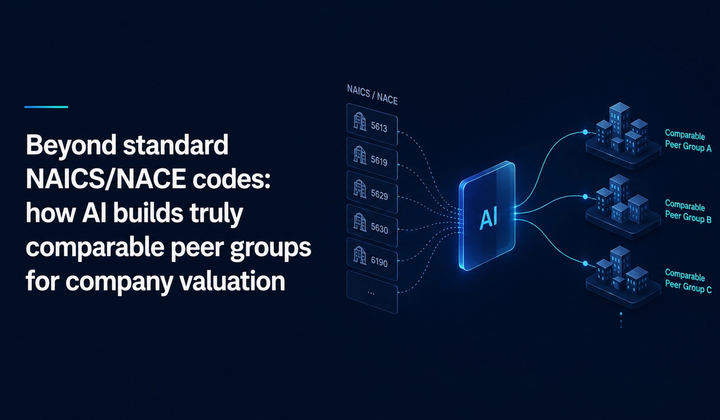
Beyond standard NAICS/NACE codes: how AI builds truly comparable peer groups for company valuation
Classic NAICS/NACE codes lump niche providers into peer groups that don’t fit. See how AI-driven classification builds comparables analysts can confidently defend.