
Cost of capital under IDW S 1 and KFS/BW 1: why your beta factor needs a paper trail
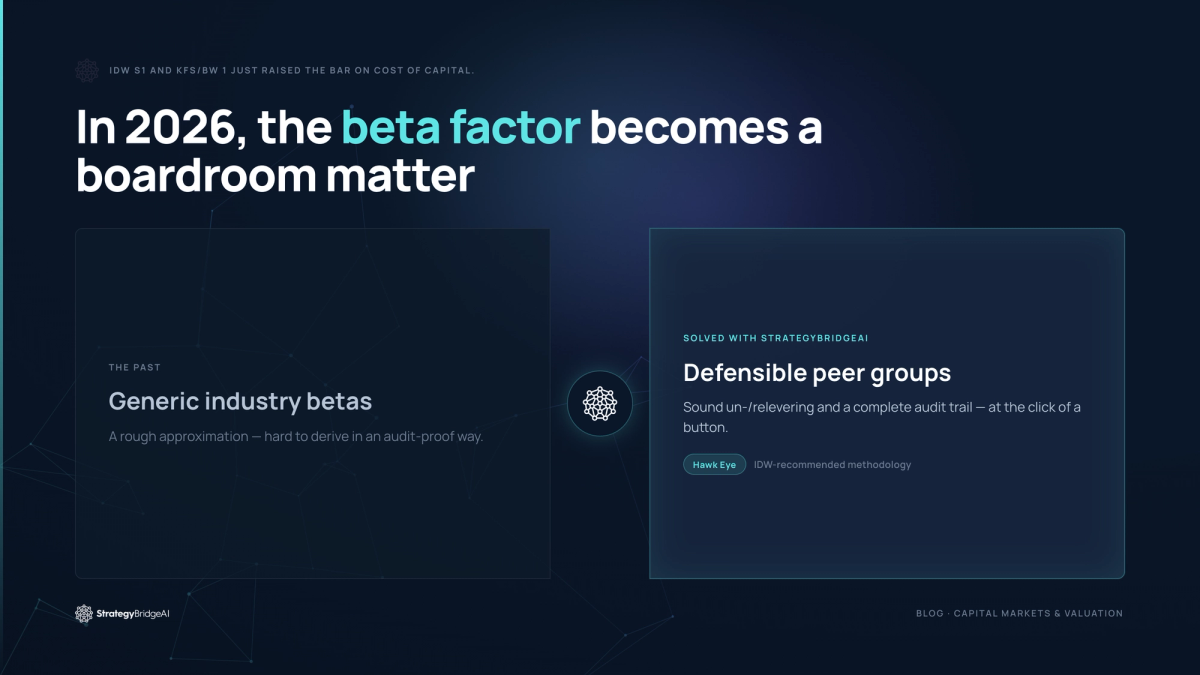
Two of the DACH region's core valuation standards were rewritten within one quarter. Germany's IDW S 1 took effect on April 8, 2026, its first full revision in 18 years. Austria's KFS/BW 1 followed on June 30, 2026, its first full revision in about a decade. Both changes reach into every fairness opinion, purchase price allocation, shareholder dispute valuation, and restructuring opinion prepared in the region.
In this article you’ll learn:
- What changed in IDW S 1 (2026) and KFS/BW 1 (2026)
- Why beta factors and peer groups have become central to defensible valuations
- How the new requirements affect M&A, audit, restructuring, and corporate finance teams
- Why SME and private company valuations are particularly challenging under the revised standards
- How StrategyBridgeAI helps build transparent, audit-ready peer groups and beta calculations with full source traceability
What changed in IDW S 1 in 2026?
The Institute of Public Auditors in Germany (IDW) adopted the revised IDW S 1 through its Expert Committee on Business Valuation and Business Administration (FAUB) on February 11, 2026. It was published o
n April 8, 2026 in IDW Life 04/2026 and applies to valuation dates from that point forward, with earlier application allowed if agreed in the engagement letter.
IDW S 1 governs valuations across a wide range of triggers: corporate law structural measures such as squeeze outs and mergers, M&A transactions including purchase price determination and fairness opinions, tax valuations, financial reporting valuations such as purchase price allocation and impairment testing, and shareholder or estate disputes.
Key changes in the 2026 revision include:
The auditor's role, whether acting as a neutral expert, neutral advisor, or consultant, now follows directly from the scope of plausibility review performed.
A clear separation between the plan management hands over and the integrated forecast the valuer must derive from it. The valuer has to independently judge whether management's plan is fit for purpose.
A new plausibilized decision value alongside the existing objectified value. Even subjective, deal specific forecasts must now fall within a defensible range.
The Capital Asset Pricing Model (CAPM) remains mandatory for the objectified value, and the market risk premium is defined explicitly for the first time.
Blanket premiums or discounts on the discount rate, such as a size premium or a marketability discount for small and mid sized companies, are no longer allowed.
Completeness representations become mandatory, and any departure from individual principles must be disclosed and justified.
What changed in KFS/BW 1 in Austria?
Austria's Expert Senate for Business Valuation at the Chamber of Tax Advisors and Auditors (KSW) adopted the revised KFS/BW 1 in November 2025 and published it in December 2025. It applies to every valuation engagement accepted from June 30, 2026 onward.
For over a decade, Austrian practice leaned almost entirely on a single value concept, the objectified enterprise value, for nearly every purpose. The 2026 revision introduces two more:
Market value, an exchange value under a disposal assumption, aligned with fair value under IFRS 13.
Typified subjective enterprise value, closer to value in use under IAS 36, reflecting a specific buyer's or holder's perspective but still validated against market evidence.
The revision also requires an unbiased forecast: a plan grounded in objective expected values and demonstrably supported by market data, not just management's internal view. It tightens the assessment of transferable earning power for small and medium sized enterprises, and it introduces a mandatory disclosure requirement whenever artificial intelligence is used in preparing the valuation.
Why does the beta factor carry more weight now?
Despite their differences, IDW S 1 and KFS/BW 1 converge on the same pressure point: the derivation of the cost of capital. IDW S 1 does it by defining the market risk premium explicitly and banning blanket adjustments for small and mid sized companies. KFS/BW 1 does it by demanding an unbiased, market grounded forecast and giving market based methods more weight through the new market value concept.
In both cases, the beta factor is where that pressure lands. It is the number that translates a company's systematic risk into the discount rate, and it now has to be derived from a peer group that a reviewer, a court, or a tax authority can actually trace back to source.
Why do private company and SME valuations create the hardest cases?
A large listed company usually has an obvious peer group. An owner managed engineering firm, a niche software company, or a regional services business does not. Standard industry codes such as GICS or NAICS rarely map cleanly onto specialized business models, and listed comparables for a EUR 15 million revenue Mittelstand company often do not exist at all.
IDW S 1 closes the usual workaround by banning blanket premiums and discounts for these cases. Both standards additionally require a documented, defensible view of owner dependency and transferable earning power. The result is more research, more documentation, and more exposure to pushback, on exactly the segment of engagements that makes up most of the DACH deal market.
What should valuation teams change in practice?
Build the peer group from the target's actual business model, not just its industry code, and document the selection criteria.
Include private comparables where listed ones do not exist, especially for SMEs.
Derive unlevered and levered beta transparently, and disclose the period, reference index, and outlier treatment used.
Benchmark the market risk premium against current FAUB or KFS/BW guidance instead of applying a round number from memory.
Assess transferable earning power and owner dependency separately for SMEs, rather than compensating with a blanket premium or discount.
Test management's plan against external market and industry data before using it as the valuation's forecast.
Obtain a completeness representation and disclose any departure from individual principles in the report.
How does StrategyBridgeAI support beta factors and peer groups under IDW S 1 and KFS/BW 1?
StrategyBridgeAI is a database and analytics platform built around exactly these requirements.
Peer group selection: semantic analysis across roughly 45,000 public companies, matched on business model rather than GICS or NAICS, plus access to more than 50 million companies from verified primary sources across 9+ European countries, including private companies missing from Capital IQ or Orbis.
Beta factors: unlevered and levered beta with proper re-levering to the target's actual capital structure, calculated against freely selectable reference indices (DAX, FTSE Europe, MSCI World, S&P 500, NASDAQ) on a daily, weekly, or monthly basis, with the underlying Excel formulas available to download and check.
Forecast plausibility: automated comparison of management's plan against competitor and industry data, the external check both standards now explicitly require.
Multiples: transaction based multiples to sanity check income approach results, as both standards still require.
Audit trail: every data point links back to its primary source, with IDW partner status and GDPR compliant handling throughout.
Compared with other industry report providers, that means roughly 10 times more sources, each classified by quality tier and validated bottom up, refreshed daily instead of updated once a year or less, and free of the rigid industry codes that leave niche and SME valuations underserved.
StrategyBridgeAI is already used by audit firms including Forvis Mazars, Möhrle Happ Luther, Renneberg, and HLB. An expanded beta factor module, fundamental industry betas for non-listed segments, and an integrated WACC calculator are in development and will ship in the coming weeks.
Explore the audit and valuation solution
If you are preparing valuations under IDW S 1 or KFS/BW 1, the peer group and beta factor are where reviewers will look first. See how StrategyBridgeAI builds both, with a full audit trail, at the push of a button.
More from this category
Explore related insights from StrategyBridgeAI.

Quality of earnings analysis in M&A: what it is and what it actually adjusts
A practical guide to quality of earnings (QoE) analysis in M&A: what it checks, the EBITDA adjustments that matter most, and how to screen a target before you commission a formal report.
Red flag due diligence: how to screen an acquisition target before the data room opens
Most deal risks are visible long before the data room opens. Here is how M&A, advisory and audit teams run a structured red flag screen while a target is still a name on a longlist.
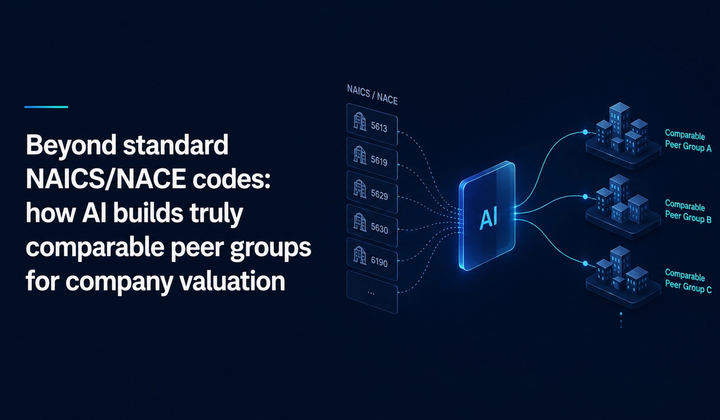
Beyond standard NAICS/NACE codes: how AI builds truly comparable peer groups for company valuation
Classic NAICS/NACE codes lump niche providers into peer groups that don’t fit. See how AI-driven classification builds comparables analysts can confidently defend.