
Why banks need a new quality of decision support in 2026
Banks are under growing pressure. Credit decisions are expected to happen faster, risks to be assessed more precisely, and opportunities to be identified more systematically, all while regulatory requirements increase and resources stay tight. At the same time, the data situation is getting more complex: company information is fragmented, qualitative assessments are hard to compare, and benchmarks are often incomplete or outdated.
For more complex engagements, particularly from a credit volume of two to five million euros upward, standardised review routines are no longer enough. In-depth company and sector analyses that go beyond the financials are becoming a prerequisite, in credit analysis as much as in acquisition finance or growth transactions. The picture that emerges is clear: classic analytical approaches and isolated digitalisation steps are hitting their limits. Efficiency gains through automation alone are not sufficient anymore. What matters is the quality of the basis on which decisions are made.
The gap between AI investment and actual decision support
Over the past few years, many banks have invested in AI applications. Custom GPT instances, Copilot solutions, and agent-based systems are no longer unusual. But the central question remains: do these solutions actually support credit-relevant decisions in market follow-up, corporate banking, and corporate finance?
The reality is sobering. Company and sector analyses are still time-intensive, largely manual, and dependent on data provided by the borrowers themselves. Standardisation, comparability, and auditability remain unsolved problems. Hallucinations, distorted datasets, and missing traceability make many AI applications unusable in regulated environments. A number of institutions have slowed down or stopped their AI use cases entirely, not for lack of innovation appetite, but because data quality, accuracy, and measurable value did not hold up.
Why data quality and context are what actually matter
Credit decisions are only as good as the data they are based on. Individual metrics without context do not deliver reliable insight. Orientation only emerges through comparison, across sectors, competitors, and time periods.
In practice, that context is frequently missing. Conventional sector databases work with broad industry codes that neither reflect the actual niche of a borrower nor allow meaningful competitive comparison. Numbers get interpreted rather than contextualised. Objectivity is lost, risks get misjudged, and opportunities are overlooked. At the same time, requirements around transparency and traceability are increasing. Results need to be explainable, auditable, and regulatorily defensible. Automation without validation creates a false sense of security, a risk banks cannot afford.
A different approach to credit-relevant analysis
Modern, data-driven solutions do not start at the surface. They work at the core of the analysis. What matters is the combination of verified data sources, financial methodology, and AI-supported contextualisation. Rather than isolated tools, the result is an integrated analytical environment:
- Aggregation of quantitative and qualitative company data
- Automated identification of relevant competitors and peers
- Standardised benchmarking across sectors and time periods
- Derivation of trends, risks, and opportunities
- Auditable results with traceable methodology
The focus shifts from data gathering to decision support. AI is not a substitute for professional judgment, but a structuring element that makes connections visible and raises objectivity.
From credit analysis to acquisition finance
Data-driven decision support becomes relevant across the entire corporate banking business, from credit analysis for upper mid-market engagements to corporate finance mandates like acquisition financing and succession planning, through to new client acquisition. For more complex borrowers, deep insight into sector dynamics, competitive positioning, and financial resilience is essential. Robust peer comparisons and market analyses shorten the analytical process and increase the persuasiveness of recommendations to decision-making committees.
For banks, the measurable advantages run across the entire credit and acquisition process:
Efficiency gains. What used to require 20 to 80 hours of manual analysis can today be prepared in minutes. Standardised company and sector analyses reduce operational effort by more than 80 percent and free up capacity for value-adding work.
Higher decision quality. Consistent benchmarks and validated data produce reliable decision foundations. Dependence on borrower-supplied data decreases, and an objective second opinion strengthens risk assessment, particularly for larger engagements with elevated exposure.
Stronger client relationships. Well-grounded analyses create new conversation opportunities in corporate banking. Advisors can identify opportunities proactively and develop tailored concepts. Analysis becomes a strategic sparring instrument.
More targeted new client acquisition. Data-supported pre-qualification enables focus on creditworthy and profitable target companies. Differentiated outreach backed by sector knowledge increases conversion rates.
In practice, the benefits are most visible in recurring scenarios: obtaining an objective second opinion on complex mid-market credit engagements, supporting due diligence in acquisition finance and corporate transactions, systematically identifying upsell and expansion opportunities within existing portfolios, data-driven pre-qualification including longlist creation for new client acquisition, and standardised sector analyses for specialised niche markets. Results are not only available quickly but also ready to use downstream, in Excel formats or in the bank's own presentation design.
Trust through methodology, security, and experience
Acceptance depends on trust. That trust does not come from promises. It comes from methodology, data quality, and proximity to real practice. A robust analytical platform is built on verified data from official registries and validated financial sources. Methods are documented, and results are traceable. StrategyBridgeAI combines these requirements and has established itself across more than 10,000 analyses and over 2,000 users in regulated environments, including banks, audit firms, and M&A advisors.
Internal acceptance is an often underestimated factor. Particularly in market follow-up, risk, and audit functions, what matters is not just the result but the path to it. Solutions need to be explainable and based on consistent logic. Only then can decisions be defended internally and justified to auditors. Decision support becomes a stable part of the governance structure.
2026 will not be the year in which banks first use AI. It will be the year in which it becomes clear which institutions have integrated it productively and responsibly into their decision-making processes. The difference does not lie in the technology, but in the quality of the implementation. Solutions that bring data, methodology, and context together create orientation in an increasingly complex world, and become a strategic advantage in competition.
Book a demo to explore this approach and assess its fit for your institution.
More from this category
Explore related insights from StrategyBridgeAI.

Quality of earnings analysis in M&A: what it is and what it actually adjusts
A practical guide to quality of earnings (QoE) analysis in M&A: what it checks, the EBITDA adjustments that matter most, and how to screen a target before you commission a formal report.
Red flag due diligence: how to screen an acquisition target before the data room opens
Most deal risks are visible long before the data room opens. Here is how M&A, advisory and audit teams run a structured red flag screen while a target is still a name on a longlist.
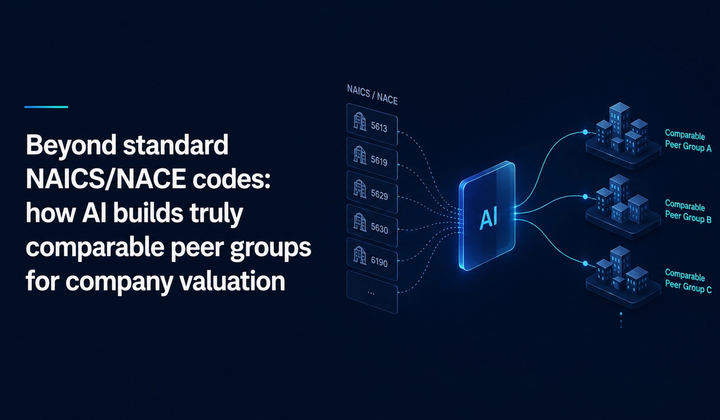
Beyond standard NAICS/NACE codes: how AI builds truly comparable peer groups for company valuation
Classic NAICS/NACE codes lump niche providers into peer groups that don’t fit. See how AI-driven classification builds comparables analysts can confidently defend.