
M&A benchmarking tools: what actually matters in 2026
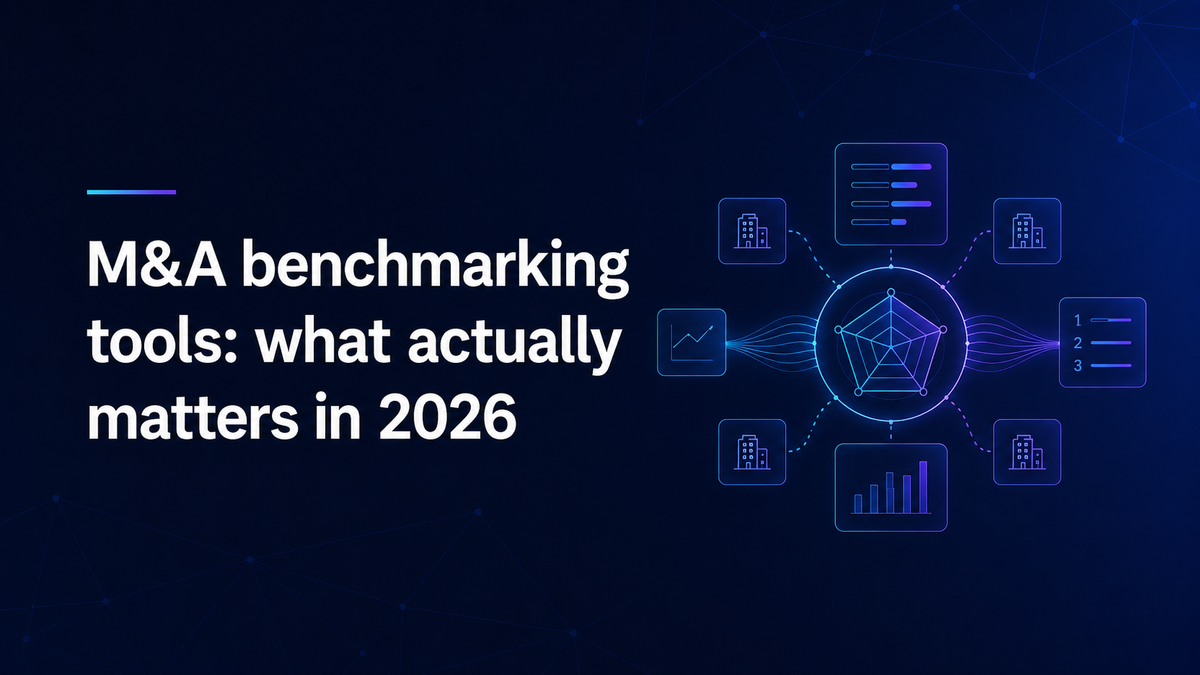
Benchmarking is one of the most routine tasks in any M&A process, and one of the most poorly done. Most deal teams still piece together peer comparisons from three or four different databases, normalise the data manually, and produce a slide that's already outdated by the time it reaches the investment committee.
The question is not whether to benchmark. It is whether the tool you are using is fit for the decisions you are actually making.
This article breaks down what M&A benchmarking tools need to do, where most fall short, and what a modern approach looks like in practice.
What is M&A benchmarking, and where does it show up in a deal?
M&A benchmarking is the process of assessing a target company's performance, positioning, and valuation relative to a defined peer group. It surfaces across nearly every stage of the deal life cycle.
During target screening and longlist creation, benchmarking helps determine whether a company's margin profile, growth rate, and capital efficiency are in line with sector peers, or whether they indicate an underperformer with a recovery story or an outlier with a premium price.
In preliminary assessment and commercial pre-DD, it provides a fast, data-driven view of competitive positioning, helping deal teams form a go/no-go hypothesis before committing to full diligence.
During valuation and IC preparation, peer multiples (EV/EBITDA, EV/EBIT, EV/Sales, P/E) become the foundation of any trading comparable analysis. The quality of the peer group and the consistency of the underlying data directly affect how defensible the valuation is in front of an investment committee or a counterparty.
What most M&A benchmarking tools get wrong
The problem with standard database tools is that they were designed for data storage, not analytical workflow. You extract data, paste it into Excel, normalise it yourself, handle outliers manually, and format the output from scratch. For a single peer comparison, that process takes hours. Across a pipeline of 20 or 30 targets, it becomes a structural bottleneck.
There are several specific failure modes that consistently appear across teams using legacy setups.
Inconsistent peer group selection. Without a clear, data-driven methodology, peer groups are selected subjectively. Two analysts working the same deal will often produce materially different comparables. That inconsistency undermines the analytical output before it is even reviewed.
No distinction between business model types. A software company and a manufacturer cannot be benchmarked against the same KPIs or multiples. Tools that apply uniform metrics across all sectors produce misleading outputs. Asset-light businesses, for example, are better assessed using the Rule of 40 alongside EBITDA margins. Asset-heavy industrials require capital intensity and return on assets to sit alongside profitability.
Static snapshots. Many tools present data at a single point in time. Deal teams need to understand how a company has performed relative to peers over three to five years, not just where it sits today. Trend data is what separates a structural winner from a cyclical blip.
No path from analysis to output. Even when the data is good, it lives in a database. Moving it into a usable format for an IC presentation or a management briefing requires a separate workflow entirely. That friction costs time and introduces errors.
Opaque outlier handling. When peer group data contains extreme values, the question of whether to include or exclude them requires clear methodology. Tools that do not surface or address outliers produce comparisons that are hard to defend.
What AI changes about the benchmarking process
The shift that AI enables is not simply speed. It is the ability to run analyses that were previously deprioritised because of time and resource constraints.
Boston Consulting Group's June 2026 analysis of AI in M&A describes the core impact clearly: AI enables diligence that is "faster, deeper, broader, and more systematically integrated." In the benchmarking context specifically, this means processing entire datasets simultaneously to surface patterns that are difficult to detect manually, including anomalies in revenue quality, margin trajectories, and working capital behaviour across a peer group.
BCG also notes that the shift toward AI-driven analysis is pulling risk identification earlier in the process, allowing teams to form a sharper view during preliminary assessment rather than waiting for formal diligence. Applied to benchmarking, this means go/no-go decisions can be grounded in competitive context from the first day of analysis, not the last.
The bottleneck is no longer access to data. It is the ability to structure, contextualise, and synthesise that data into something a deal team can actually act on.
What a best-in-class M&A benchmarking tool needs to deliver
A benchmarking tool that is genuinely useful in an M&A context needs to satisfy several criteria.
Automated, methodologically sound peer group construction. The tool should identify a relevant peer group based on business model, sector, geography, and size, and apply consistent selection criteria, not a manual search of a database. Peer groups of 20 to 60 companies, with transparent data quality filters and outlier handling, are the standard worth aiming for.
Multi-dimensional KPI comparison. Revenue growth, EBITDA margin, EBIT margin, return metrics, capital intensity, and leverage should all be visible in a single view, indexed against the peer group and industry average, so relative positioning is immediately readable without additional processing.
Business model sensitivity. The tool should adapt its metrics framework to the type of business being analysed. A SaaS company and a capital goods manufacturer are not comparable on the same axes, and the benchmarking output should reflect that.
Target value identification. The most analytically useful output is not just where a company stands today, but what a realistic improvement trajectory looks like based on where the next-best performer in the peer group sits. That gives deal teams a grounded basis for synergy and improvement case construction.
Historical trend context. Current KPI performance means far less without a three to five year historical view. The pattern of improvement or deterioration, relative to peers, is often more telling than an absolute margin figure.
Output that is ready for use. For a benchmarking tool to actually save time in an M&A process, the output needs to be presentable directly. If the end result still requires manual formatting, the efficiency gain is marginal.
How StrategyBridgeAI's Hawk Eye addresses these requirements
Hawk Eye is StrategyBridgeAI's outside-in analysis module, designed specifically for the M&A, private equity, and corporate finance workflow. It covers five analytical layers in a single platform: competitor and peer analysis, benchmarking, sector analysis, valuation multiples, and financial forecasting.
The peer group construction in Hawk Eye draws on a database of around 50 million companies. Peer groups of up to 60 companies can be built from public financial data, with automated data quality filters that ensure only companies with sufficient data density are included in the comparison. Outliers are flagged rather than silently included, and the selection can be customised to reflect specific analytical requirements.
KPI benchmarking is standardised relative to the overall market, making relative positioning immediately readable. The framework is adapted to business model type: asset-light models, including software companies, are assessed against metrics like the Rule of 40, while asset-heavy industries are assessed against capital intensity and asset structure. That distinction matters significantly when benchmarking a manufacturing target against a mix of peers with different balance sheet structures.
Hawk Eye also surfaces target values based on the next-best performer in the peer group, not theoretical optima, giving deal teams an empirically grounded basis for improvement and synergy case construction.
The historical view spans multiple years, allowing relative performance trends to be assessed alongside current positioning. This is integrated into a strategy matrix that links KPI development to competitive positioning across time, so teams can see whether a weakness is structural or already improving.
On the valuation side, Hawk Eye delivers implied multiples across EV/Sales, EV/EBITDA, EV/EBIT, P/E, and equity-based metrics, drawing on trading comparables and sector data. The output is formatted for direct export in the client's own design, which removes the reformatting step between analysis and presentation.
The overall time saving reported by StrategyBridgeAI users is above 80%. What previously required 20 to 80 hours of manual work across competitor identification, data aggregation, benchmarking, forecasting, and report preparation can be completed in 15 to 30 minutes.
Hawk Eye is recommended by IDW (Institut der Wirtschaftsprüfer), and is used across M&A advisory, private equity, corporate M&A, and audit.
How Hawk Eye compares to alternatives like PitchBook, Dealogic, and Alphasense
Standard M&A platforms each cover parts of the benchmarking workflow. PitchBook provides strong transaction data and financial history for public and private companies. Alphasense is well-suited to qualitative intelligence from broker research and earnings call transcripts. Dealogic is primarily a deal tracking and league table tool.
What none of these platforms deliver natively is an integrated, automated benchmarking workflow that goes from peer group selection through to formatted IC-ready output in a single session. Each requires significant manual work to bridge the gap between raw data and usable analysis.
The distinction is not about data breadth alone. It is about whether the tool produces analysis you can use, or data you still have to process.
Practical use cases: where Hawk Eye delivers the most value
Commercial pre-DD. Before committing to full due diligence, a team needs to validate that the target's market position and financial profile justify the investment thesis. Hawk Eye's competitive positioning and sector analysis modules provide that view from public data, without depending on management presentation.
Valuation range construction. Using trading multiples and peer group data, with adjustments for size and business model differences, to produce a defensible valuation range for an IC submission.
Red flag assessment. Identifying whether a target's margin deterioration, revenue growth deceleration, or leverage increase is company-specific or sector-wide. Peer group context is often what distinguishes a structural risk from cyclical noise.
IC presentation preparation. Exporting benchmarking charts, multiple tables, and competitive positioning visuals directly in the client's own design, without additional formatting work.
The compounding advantage of systematic benchmarking
One of the most underappreciated aspects of using a structured benchmarking tool consistently across a deal pipeline is the institutional learning it enables.
BCG's 2026 M&A analysis identifies this as the defining shift in how AI is changing dealmaking: the move from episodic, experience-driven processes to a continuous, data-driven learning system where each transaction informs the next. In the context of benchmarking, this means that teams who run systematic peer comparisons on every deal, and capture the results in a consistent format, progressively sharpen their sector intuition and valuation pattern recognition in a way that is difficult to replicate through manual experience alone.
The companies that build this discipline early will hold a structural advantage. The difference between a team that benchmarks systematically and one that does it ad hoc is not just speed on a single deal. It is the cumulative accuracy of investment judgement across an entire portfolio or deal pipeline.
StrategyBridgeAI: the new standard of business analysis
StrategyBridgeAI is built by a team of 30 specialists from corporate finance, data analytics, and AI. The platform serves over 2,000 users across M&A advisory, private equity, audit, consulting, and banking.
Hawk Eye is the outside-in analysis module at the core of the platform, covering peer benchmarking, sector analysis, valuation multiples, and financial forecasting in a single workflow. It is the part of the platform most directly relevant to deal teams that need fast, defensible, presentation-ready analysis.
If your team is spending more time building benchmarking slides than evaluating the underlying business, that is a solvable problem.
See Hawk Eye in action. Book a demo at strategybridge.ai.
Source reference: Kengelbach, J., Friedman, D., Shivraj, A., Wang, Y., El Bouri, O., Degen, D. (2026). "AI Is Turning M&A into a High-Impact Learning Machine." Boston Consulting Group, June 10, 2026.
More from this category
Explore related insights from StrategyBridgeAI.
Quality of earnings analysis in M&A: what it is and what it actually adjusts
A practical guide to quality of earnings (QoE) analysis in M&A: what it checks, the EBITDA adjustments that matter most, and how to screen a target before you commission a formal report.
Red flag due diligence: how to screen an acquisition target before the data room opens
Most deal risks are visible long before the data room opens. Here is how M&A, advisory and audit teams run a structured red flag screen while a target is still a name on a longlist.
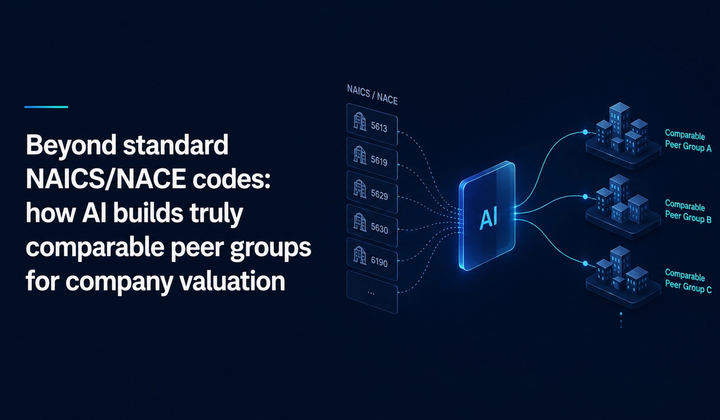
Beyond standard NAICS/NACE codes: how AI builds truly comparable peer groups for company valuation
Classic NAICS/NACE codes lump niche providers into peer groups that don’t fit. See how AI-driven classification builds comparables analysts can confidently defend.