
Automated commercial due diligence: how AI helps strategy teams validate market assumptions in hours instead of weeks
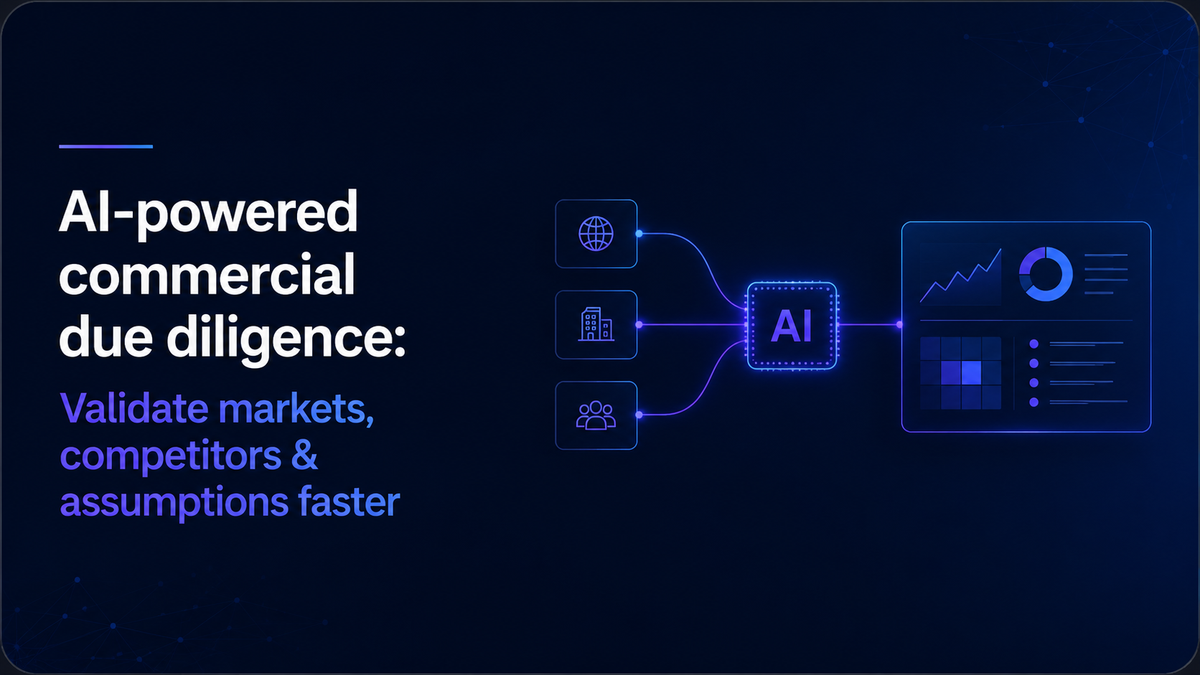
Automated commercial due diligence: how AI helps strategy teams validate market assumptions in hours instead of weeks
Commercial due diligence has always been about reducing uncertainty. Before a board approves an acquisition or an investment committee signs off on a deal, one question needs to be answered: Does the commercial thesis actually hold up?
Answering that question requires much more than an opinion. Teams need to understand the market, benchmark competitors, validate growth assumptions, assess structural risks and explain every number they present. The challenge isn’t knowing what to analyse. It’s assembling all the evidence before the real analysis can even begin. Today, that process is still surprisingly manual. Analysts spend days collecting market reports, comparing conflicting sources, downloading financial statements, benchmarking competitors and rebuilding everything into presentations. Only then can the strategic discussion start. Artificial intelligence doesn’t eliminate commercial due diligence. It removes the manual work that slows it down.
In this article you’ll learn
- Why commercial due diligence projects spend more time collecting information than analysing it
- Which parts of market validation can safely be automated with AI
- How leading strategy and M&A teams structure AI-supported due diligence workflows
- Where human judgement remains essential
- What board-ready commercial due diligence looks like when research is automated
The hidden bottleneck in commercial due diligence
Ask experienced M&A professionals where they lose the most time during a commercial due diligence engagement. Very few will answer: “Thinking.” Instead, the answer usually looks something like this:
- Finding reliable market data
- Comparing inconsistent market estimates
- Identifying relevant competitors
- Collecting historical financials
- Building peer groups
- Creating charts and presentations
- Verifying every source
None of these tasks are strategically difficult. They’re simply repetitive. Yet they often consume the majority of the timeline. By the time the market picture is complete, only a fraction of the available project time remains for discussing what the findings actually mean for the investment thesis. That’s the real bottleneck AI is beginning to remove.
Commercial due diligence still revolves around the same three questions
| Question | Required evidence |
|---|---|
| Is this an attractive market? | Market size, growth, trends, value chain, regulation |
| Can the company win? | Competitive positioning, market shares, differentiation, entry barriers |
| Can the investment thesis fail? | Risks, cyclicality, customer concentration, disruption, external factors |
These questions remain exactly the same. What changes is how quickly evidence can be assembled.
Where AI creates the biggest impact
Many discussions around AI focus on replacing analysis. That’s the wrong perspective. The greatest productivity gains come much earlier. Modern AI platforms automate the assembly of evidence. Instead of searching dozens of databases individually, analysts receive a structured market overview, peer landscape and company information within hours. The time previously spent collecting information can instead be invested in evaluating scenarios, challenging assumptions and preparing recommendations. In other words: AI shifts effort from research towards judgement. That is exactly where experienced deal professionals create value.
A practical AI workflow for commercial due diligence
The strongest commercial due diligence teams don’t use AI as a chatbot. They build repeatable workflows. A typical process looks like this.
Step 1: Build a reliable market view
Every investment thesis starts with the market.
Teams first validate:
- Market size
- Historical development
- Expected growth
- Industry trends
- Value chain
- Customer segments
- Regulatory environment
- Entry barriers
Instead of combining multiple disconnected reports manually, AI-supported market intelligence platforms generate a comprehensive, source-backed market analysis that can immediately be reviewed by the project team. The objective isn’t replacing external evidence. It’s consolidating it.
Step 2: Benchmark competitors
Once the market context is established, attention shifts to competitors.
This includes:
- financial performance
- profitability
- valuation multiples
- strategic positioning
- business models
- ownership
- historical development
- SWOT analysis
Instead of analysing every competitor individually, AI can assemble comparable company profiles automatically, creating a consistent basis for benchmarking. The strategic interpretation remains entirely with the deal team.
Step 3: Validate company-level evidence
Market assumptions are only as reliable as the underlying company data.
Professional workflows therefore combine:
- company information
- financial statements
- ownership structures
- transaction history
- corporate hierarchies
- management information
Keeping all information on one platform significantly improves traceability. Every figure can be linked back to an identifiable source. That becomes particularly valuable during investment committee discussions, where every assumption may be challenged.
Step 4: Deliver board-ready output
Perhaps the least discussed productivity gain is presentation creation. Many analysts spend hours rebuilding research into PowerPoint. Modern AI workflows generate structured, presentation-ready outputs directly from validated research, allowing teams to focus on refining the investment story rather than formatting slides.
What AI should validate, and what humans should decide
| AI excels at | Human expertise remains essential |
|---|---|
| Market research | Investment decisions |
| Peer benchmarking | Commercial judgement |
| Company screening | Industry expertise |
| Financial comparisons | Scenario planning |
| Source aggregation | Negotiation strategy |
| Report generation | Investment committee recommendations |
The distinction is important. The objective isn’t autonomous due diligence. It’s better-informed due diligence.
Why integrated platforms matter
Many firms already use AI. Yet productivity gains often remain limited because workflows are fragmented. One tool produces market summaries. Another provides financial data. A third generates presentations. Analysts still spend considerable time transferring information between systems. Integrated platforms solve a different problem. They combine market intelligence, company databases, peer benchmarking and AI-powered analysis into one continuous workflow. That reduces manual handovers, improves consistency and makes every conclusion easier to verify.
How StrategyBridgeAI supports commercial due diligence
StrategyBridgeAI was designed around exactly this workflow. Rather than replacing experienced deal professionals, the platform accelerates the research phase that traditionally consumes most of a commercial due diligence project.
Teams can combine:
- AI-generated market intelligence through Niche Market Reports
- Automated peer benchmarking through Outside-In-Business Analysis
- Company, financial and transaction data across approximately 50 million companies in more than 100 countries
- Board-ready outputs with fully traceable sources
Because every module operates on the same underlying data layer, market insights, peer analysis and company information remain consistent throughout the project. That allows strategy teams to spend significantly less time collecting information and considerably more time evaluating what it means for the investment.
The future of commercial due diligence isn’t fully automated
Commercial due diligence has always depended on experience. That won’t change. Investment decisions require judgement. Management interviews still matter. Industry expertise remains indispensable. What is changing is the amount of manual work required before experts can apply that judgement. As AI continues to mature, the competitive advantage will no longer come from collecting more information. It will come from reaching reliable conclusions faster than everyone else. For strategy teams, corporate development departments, private equity firms and M&A advisors, that shift is already underway.
Want to see how this looks in practice: request a demo with StrategyBridgeAI.
Frequently asked questions
What is automated commercial due diligence?+
Automated commercial due diligence uses AI to accelerate market research, competitor benchmarking and company analysis while leaving strategic assessment and investment decisions to experienced professionals.
Can AI replace commercial due diligence consultants?+
No. AI automates research-intensive tasks but does not replace commercial judgement, sector expertise or investment decision-making.
How much time can AI save during commercial due diligence?+
The greatest savings come from eliminating manual research, data collection and presentation preparation. Depending on project scope, this can reduce work that traditionally takes days or weeks to only a few hours.
What information can AI validate?+
AI is particularly effective at validating market size, growth trends, peer benchmarks, financial KPIs, ownership structures and publicly available company information from trusted sources.
Why is source traceability important?+
Investment committees, boards and clients need to understand where assumptions originate. Traceable sources improve transparency, increase confidence and make findings easier to defend.
More from this category
Explore related insights from StrategyBridgeAI.
Red flag due diligence: how to screen an acquisition target before the data room opens
Most deal risks are visible long before the data room opens. Here is how M&A, advisory and audit teams run a structured red flag screen while a target is still a name on a longlist.
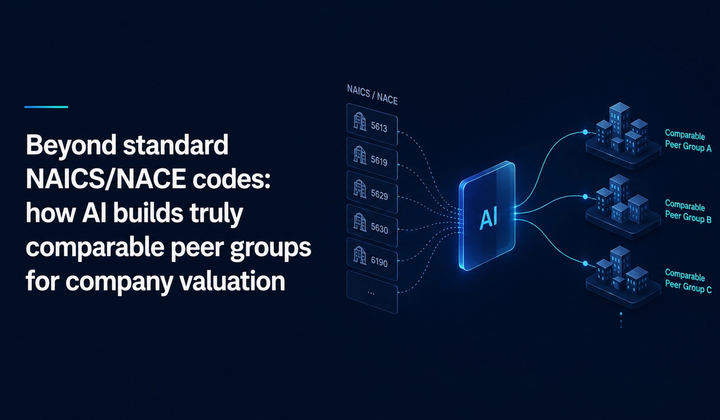
Beyond standard NAICS/NACE codes: how AI builds truly comparable peer groups for company valuation
Classic NAICS/NACE codes lump niche providers into peer groups that don’t fit. See how AI-driven classification builds comparables analysts can confidently defend.
Company valuation tools for M&A: a practical breakdown and what to look for
Valuation is where deal decisions get made and defended. Here is a practical breakdown of what valuation tools need to deliver for M&A, PE, and advisory teams, and which approach holds up best.