
Red flag due diligence: how to screen an acquisition target before the data room opens

By the time a data room opens, a buyer has usually spent weeks on a target: management calls, an indicative offer, an LOI, and in most processes an exclusivity clock that is already running. That is an expensive moment to discover that half the revenue sits with two customers, that the founder is the only person with technical know-how, or that the market the target operates in has been shrinking for three years.
Red flag due diligence exists to move that discovery earlier. It is a deliberately shallow, deliberately fast screen that asks one question: is there anything here serious enough to stop, reprice, or restructure the deal before we commit real money and real time? Done properly, it runs before the LOI, on public and third-party data, without ever asking the seller for a file.
In this article you'll learn:
- Why a pre-LOI red flag screen changes your negotiating position, not just your risk register
- Which risk categories can genuinely be assessed from the outside, and which have to wait for the data room
- How to run the screen as a repeatable workflow instead of an ad hoc web search
- How to document findings so they survive a partner review or an investment committee
- Where AI shortens the work and where a human still has to make the call
What red flag due diligence actually is
Red flag due diligence is a risk-first, materiality-driven review that looks only for deal breakers and deal changers. It is not a smaller version of full due diligence. Full due diligence is designed to confirm and quantify; a red flag review is designed to detect and prioritise. The output is not a 120-page report, it is a short list of issues ranked by how much they could move price, structure, or the decision to proceed at all.
The term is standard market vocabulary in advisory and audit practice, most often used for a scoped legal or financial review delivered as a red flag report. What has changed is the timing. Because far more company, market and ownership data is now accessible without seller cooperation, the same discipline can be applied one step earlier, while the target is still an unapproached name on a longlist.
Where it sits in the deal process
Screening depth by deal stage
| Stage | Question you are answering | Data available | Typical effort |
|---|---|---|---|
| Longlist screening | Does this target fit the mandate at all? | Public and third-party data only | Minutes per target |
| Pre-LOI red flag screen | Is there anything here that should stop or reprice the deal? | Public and third-party data, plus first management impressions | Hours per target |
| Confirmatory due diligence | Are the numbers and contracts what the seller says they are? | Data room, management sessions, expert interviews | Weeks per target |
| Signing to closing | Have the conditions and risk allocation been settled? | Negotiated disclosures, warranties, SPA schedules | Weeks, legal-led |
The pre-LOI screen is the cheapest point in the process at which you can still walk away for free. After the LOI, walking away costs advisory fees, internal capacity and, in a competitive process, credibility with the seller.
What you can actually see from the outside
The honest answer is: more than most deal teams assume, and less than a data room. An outside-in screen cannot tell you what is in the customer contracts. It can tell you, with reasonable confidence, whether the target's financial trajectory, market position, ownership structure and management stability contain something that deserves attention before you commit.
Outside-in signals and what they are worth
| Signal | Where it comes from | What it can tell you | What it cannot tell you |
|---|---|---|---|
| Multi-year financial trend | Filed annual accounts and financial statements | Margin erosion, working capital drift, rising leverage | Whether an effect is one-off or structural |
| Peer benchmarking | Comparable companies in the same real market | Whether under-performance is company-specific or sector-wide | The quality of internal cost allocation |
| Market development | Industry data, associations, sector studies, press | Structural decline, price pressure, regulatory shifts | The target's share of that market with precision |
| Ownership and group structure | Commercial register and group filings | Hidden affiliates, related-party set-ups, financing structures | Side agreements and undocumented arrangements |
| Management and hiring signals | Job portals, company communications, professional networks | Turnover in key roles, key-person dependency, hiring freezes | Why an individual actually left |
| Adverse media and litigation | Press, official announcements, public proceedings | Reputational and compliance exposure | The likely financial outcome of a case |
Seven red flag categories worth screening before the LOI
Pre-LOI red flag categories
| Category | What to look for | Why it matters pre-LOI |
|---|---|---|
| Earnings quality | Revenue growth not matched by cash flow, aggressive EBITDA adjustments, margin outliers versus peers | Directly moves the multiple and the bridge to your offer |
| Concentration | Dependency on a few customers, suppliers, or one product line | Changes deal structure: earn-outs, escrow, retention |
| Market trajectory | A shrinking or structurally pressured niche, substitution risk | A good company in a bad market rarely earns your business case |
| Key-person dependency | Owner-managed operations, thin second tier, no succession plan | Determines whether you are buying a business or a person |
| Balance sheet structure | Rising leverage, pension obligations, off-balance-sheet commitments | Affects the equity story and the financing case |
| Compliance and legal exposure | Litigation, regulatory proceedings, licence and permit issues | Can be a hard stop for listed and regulated acquirers |
| Structure and related parties | Opaque group structures, affiliate transactions, unclear ownership | Predicts how painful the confirmatory phase will be |
A five-step pre-LOI red flag screen
- Fix materiality first. Define what would actually change your decision, for example any issue worth more than a set percentage of enterprise value or any dependency above a threshold share of revenue. Without this, a red flag screen turns into a list of observations nobody acts on.
- Build the financial trend. Pull several years of filed figures and look at the direction, not the latest year. Most structural problems show up as a trend long before they show up in a single set of accounts.
- Benchmark against a real peer group. Peers defined by industry code alone will hide the problem. The comparison only works when the peer set reflects the target's actual business model, product focus and region.
- Read the market, not just the company. Establish whether the niche itself is growing, flat or under structural pressure, and what drives that. This is the check most often skipped and most often decisive.
- Write the flags down with evidence and a next step. Each flag gets a source, a materiality assessment, and one of three verdicts: stop, reprice, or verify in the data room.
Make the screen defensible, not just fast
A red flag screen that cannot be traced back to sources is not usable in a partner review, an investment committee, or a board paper. Every flag needs an origin, a date, and a stated confidence level. That discipline matters twice: once when you argue for a price reduction, and once when someone asks, two years later, whether the risk was known before signing.
It also protects you in the other direction. A documented screen that found nothing material is a legitimate, defensible reason to move forward quickly, which in a competitive process is a real advantage.
Because information is available faster and at higher quality, our analyses are more meaningful.
Nikolai Üstündağ, Senior Manager at WTS Advisory
Where AI helps, and where it does not
AI is genuinely good at the part of this work that is broad and repetitive: assembling multi-year financials, finding comparable companies that no industry code would group together, scanning market and media sources at scale, and structuring the result into something readable. That is where the hours go, and that is where the compression happens.
AI is not the right instrument for the judgement call. Whether customer concentration is a stop or a structuring issue depends on your strategy, your risk appetite and your integration plan. The value of automation here is that it gets a deal team to the judgement call in hours instead of weeks, with better evidence underneath it.
How StrategyBridgeAI supports a pre-LOI red flag screen
StrategyBridgeAI is built for exactly this outside-in phase: everything you can establish about a company and its market before anyone opens a data room. The platform draws on a database of around 50 million public and private companies across more than 100 countries, and is recommended by the Institut der Wirtschaftsprüfer (IDW).
- **Outside-in business analysis** produces a company snapshot with financial KPIs, peer benchmarking, a risk heatmap and SWOT, delivered as a board-ready presentation in your own corporate design
- **Best-in-class longlists** find targets, buyers and comparable companies through a chat-based search that is not bound to rigid industry codes, so niche players and mid-sized companies do not fall through
- **On-demand niche market reports** cover the market side of the screen: structure, trends, entry barriers, risks, built on current data rather than a report written months ago
- **Comprehensive global coverage** supplies the underlying company data, including group structures, financial KPIs, product portfolios, and ownership structures down to the ultimate beneficial owner in Germany
Across the analysis work the platform covers, teams save around 80% of the time on average: what traditionally takes 20 to 120 hours is typically done in under five. The annual customer renewal rate is 97%.
Frequently asked questions
What is red flag due diligence?+
Red flag due diligence is a scoped, risk-first review that looks only for issues material enough to stop a deal, change the price, or change the structure. Unlike full due diligence, it is designed to detect and prioritise risk rather than to confirm and quantify it, and it is usually delivered as a short red flag report rather than a full diligence report.
When should red flag due diligence be done?+
Best practice is to run a light screen before signing the LOI or term sheet, and full confirmatory due diligence afterwards during exclusivity. Screening before the LOI is the last point at which a buyer can walk away without having spent significant advisory fees or internal capacity.
Can you run due diligence on a target without seller cooperation?+
You cannot run full due diligence, but you can run a substantial outside-in screen. Filed financial statements, commercial register data, peer benchmarking, market data, hiring signals and adverse media are all accessible without the seller. What requires cooperation is contract-level detail: customer terms, employment agreements, and internal reporting.
What is the difference between red flag due diligence and a full due diligence report?+
Scope and purpose. A red flag review is materiality-driven, covers only high-impact categories, and typically takes days. A full due diligence report is comprehensive, quantifies findings, feeds directly into the SPA and purchase price mechanism, and typically takes weeks with a larger team.
What are the most common red flags in an acquisition target?+
The recurring ones are revenue growth not backed by cash flow, aggressive EBITDA adjustments, high customer or supplier concentration, key-person dependency, undisclosed or off-balance-sheet liabilities, litigation and regulatory exposure, and opaque group or related-party structures.
Can AI-generated analysis be trusted for due diligence work?+
It depends on how the analysis is produced. StrategyBridgeAI uses proprietary deterministic machine learning models for anything mathematical, such as estimating figures or running valuations, because that part cannot tolerate hallucination, and leading language models only where language and semantics are involved, such as niche search queries and company mapping. All data processing runs on European server infrastructure, and client data never flows back into the training of public models.
If you want to see what a pre-LOI red flag screen looks like on one of your own targets, book a demo and we will run it with you on a live example.
More from this category
Explore related insights from StrategyBridgeAI.

Quality of earnings analysis in M&A: what it is and what it actually adjusts
A practical guide to quality of earnings (QoE) analysis in M&A: what it checks, the EBITDA adjustments that matter most, and how to screen a target before you commission a formal report.
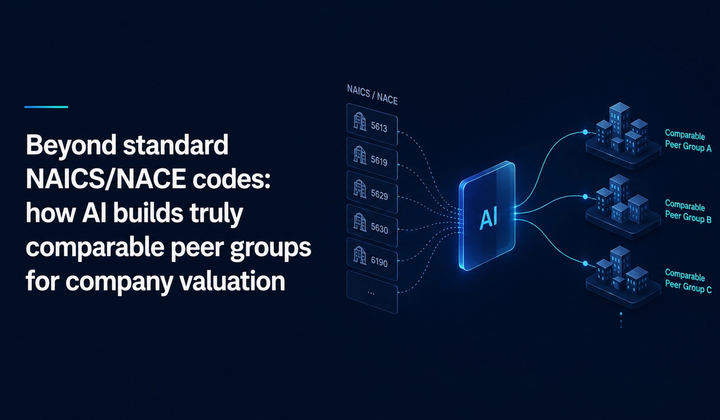
Beyond standard NAICS/NACE codes: how AI builds truly comparable peer groups for company valuation
Classic NAICS/NACE codes lump niche providers into peer groups that don’t fit. See how AI-driven classification builds comparables analysts can confidently defend.
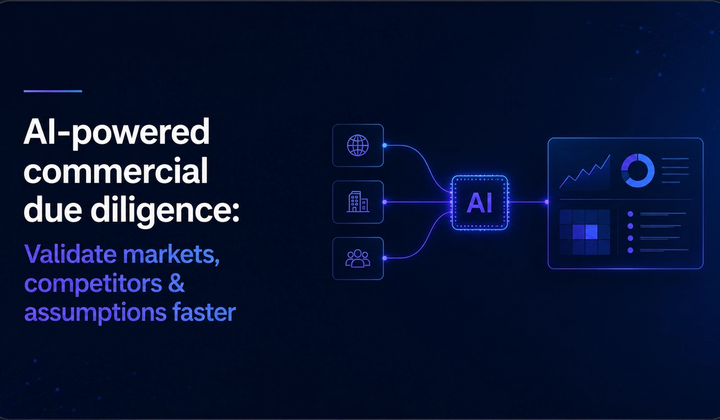
Automated commercial due diligence: how AI helps strategy teams validate market assumptions in hours instead of weeks
Commercial due diligence isn’t slowed down by analysis, but by research. See how AI helps strategy and M&A teams validate markets in hours instead of weeks.