
Beyond standard NAICS/NACE codes: how AI builds truly comparable peer groups for company valuation
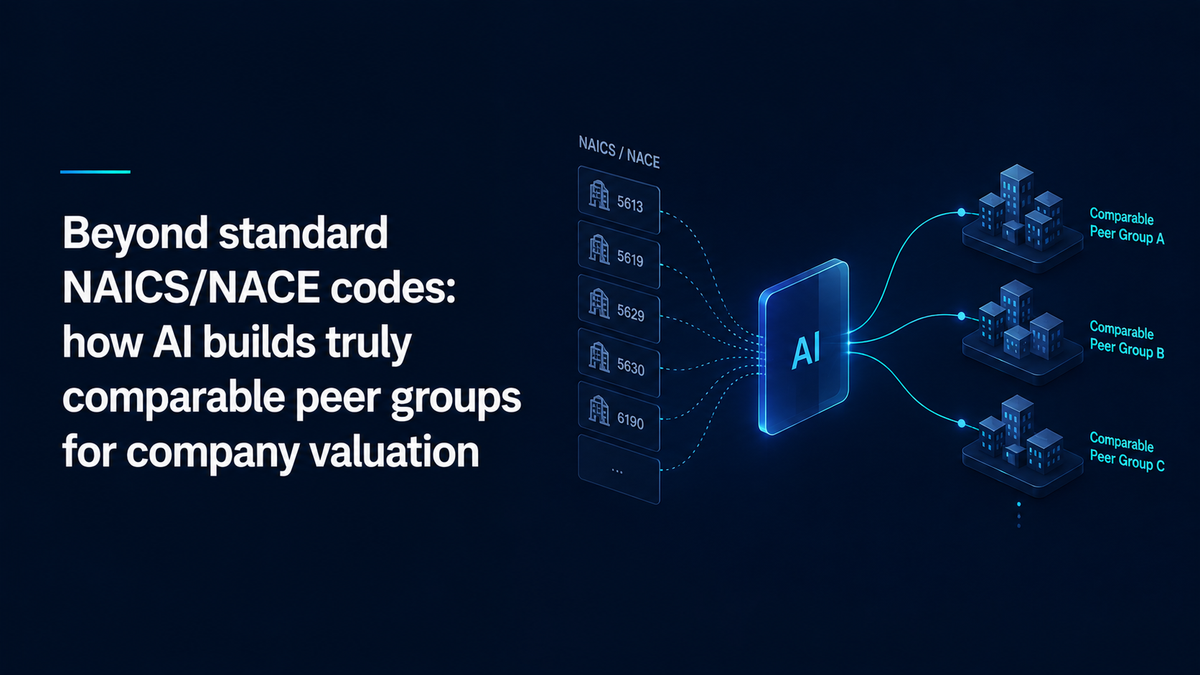
Every valuation based on comparable multiples is only as strong as the peer group behind it. Yet for most analysts, that peer group still begins with a classification code: a NAICS code in the US, a NACE code in Europe, or an internal sector tag pulled from a commercial database. That’s a sensible starting point for a manufacturer or retailer. It quickly breaks down, however, when the target is a niche software provider, a hybrid services business, or any company that doesn’t fit neatly into a four- or five-digit classification.
The issue isn’t that NAICS and NACE are flawed frameworks. They were designed for statistical reporting rather than M&A comparables, forcing a single classification onto businesses whose true competitive landscape spans multiple categories. When the peer group is inaccurate, the resulting multiple is too—and every valuation built on it inherits that weakness. This is where AI-driven, logic-based classification fundamentally changes the process. Instead of matching companies by code, it evaluates what they actually do, who they compete with, and how they generate revenue.
In this article you’ll learn:
- Why NAICS and NACE codes were never intended for valuation work—and where they consistently fall short
- The specific failure points that affect niche providers, KMUs, and hybrid business models most
- How inaccurate classifications distort EV/EBITDA and EV/Revenue multiples
- How logic-based, chat-driven target search changes the way peer groups are built from scratch
- How AI-sourced comparables integrate with subsequent benchmarking and valuation work
- What to verify before presenting a multiples analysis built on an AI-generated peer group
Beyond standard NAICS/NACE codes: how AI builds truly comparable peer groups for company valuation
Multiples analysis stands or falls with the quality of the peer group. Get the comparables right, and an EV/EBITDA or EV/Revenue multiple provides a credible view of value. Get them wrong, and you’re anchoring a valuation to companies that resemble the target only within a classification system that was never designed for this purpose.
Why NAICS and NACE were never designed for valuation work
NAICS (North American Industry Classification System) and NACE (Nomenclature statistique des activités économiques dans la Communauté européenne) were created for statistical and regulatory purposes, including national accounts, labour statistics, and tax administration. Both assign a single code to a company, typically based on its primary revenue-generating activity, and both are updated on multi-year cycles that move far more slowly than today’s business models evolve.
That approach works well when asking, “How many companies manufacture packaging in Bavaria?” It is far less effective when asking, “Which companies should I compare this business with when building a valuation?”
In practice, three structural limitations appear repeatedly.
One code per company.
A business generating revenue from software licensing, managed services, and hardware resale is classified according to whichever activity contributes the largest share of revenue today—even if the fastest-growing or most valuable part of the business lies elsewhere.
Category boundaries that are either too broad or too narrow.
A single NAICS or NACE code covering “software publishers” may include cybersecurity vendors, gaming companies, and highly specialised enterprise software providers. That’s far too broad for building a precise, defensible peer group. At the same time, genuinely comparable businesses operating just outside that category are excluded simply because they received a different code.
Update lag.
Classification systems follow fixed revision cycles rather than reflecting how markets evolve in real time. New business models—particularly in software and technology-enabled services—often emerge long before an appropriate classification exists.
Where this hits hardest: niche providers and KMUs
These limitations matter most for the companies where peer group quality has the greatest impact: niche providers and small and mid-sized enterprises whose business models don’t align neatly with a standard classification.
A specialised industrial software company, a vertical-focused consultancy, or a regional services provider with an unconventional revenue mix often has no truly appropriate classification. Analysts then face two imperfect choices: broaden the peer group until it contains businesses with fundamentally different growth profiles and margin structures, or narrow it until too few comparables remain to support a statistically meaningful valuation.
Neither outcome produces a robust result.
A peer group that’s too broad can understate or overstate the multiple by averaging businesses that don’t compete for the same customers or capital. A peer group that’s too narrow gives disproportionate weight to one or two outlier companies.
| Approach | How peer groups are built | Common failure for niche companies |
|---|---|---|
| Classic code-based screening (NAICS/NACE) | Filter a database using a single fixed industry code | Niche and hybrid business models are often misclassified, excluded entirely, or grouped into overly broad categories |
| Manual analyst research | Analysts build a longlist manually by researching each potential comparable | Thorough but time-intensive (often 20–120 hours per case) and inherently limited by the analyst’s existing market knowledge |
| AI-driven, logic-based classification | Match companies based on business description, revenue model, and competitive positioning, independent of rigid industry codes | Identifies smaller or less visible companies that code-based filters or purely manual research would typically overlook |
What changes when classification is logic-based instead of code-based
An AI-driven approach to building peer groups doesn’t begin with a fixed industry code. Instead, it starts with what a company actually does: its business model, revenue streams, target customers, and competitive positioning. This allows companies to be grouped based on genuine comparability rather than shared classification codes, while also surfacing smaller or less visible businesses that would never appear in a traditional database screen.
This is exactly the gap StrategyBridgeAI’s Longlist module is designed to close. It provides a chat-based, logic-driven target and buyer search that operates independently of rigid industry classifications, making it possible to identify KMUs and niche providers that conventional databases simply don’t surface. Analysts can refine results using granular filters, enrich company profiles with web data, export directly to Excel, or upload and enrich an existing longlist instead of starting from scratch. The same underlying logic applies whether the objective is identifying acquisition targets or building a defensible valuation peer group. Strategic buyers, financial investors, and their contact information are all generated through the same search workflow.
As Dr. Dirk Pramann, Managing Partner at Mition GmbH, explains:
“For us, longlisting is the greatest added value. We now work systematically rather than subjectively—and much faster.”
The move from subjective, code- and memory-driven screening to a structured, systematic process is precisely what makes a peer group more defensible.
From peer group to multiple: where benchmarking takes over
Building the right peer group solves only the first half of the valuation challenge. The second half is converting that peer group into a meaningful valuation through benchmarking: collecting financial KPIs, historical performance, and comparable multiples for every company on the list, then structuring the information into a format suitable for an investment committee.
StrategyBridgeAI’s Hawk Eye module supports this outside-in company analysis by combining competitor benchmarking, peer analysis, SWOT assessments, industry analysis, historical trends, valuation, and forecasting into a comprehensive Company Snapshot. The output includes financial KPIs, a business model summary, a company structure overview, and a risk heatmap before being exported directly into a board-ready PowerPoint presentation in the firm’s corporate design rather than leaving analysts with raw data that still requires manual formatting.
The combination of both capabilities is significantly more powerful than either one on its own. A peer group built on business logic rather than industry codes, combined with structured benchmarking using financial and transaction data, creates a valuation that can withstand scrutiny when clients or investment committees ask why specific comparables were selected.
Nikolai Üstündag, Senior Manager M&A at WTS Advisory, describes the impact on valuation work:
“We used to spend two or three weeks on longlists. Now we can get it done in two to three afternoons.”
Dr. Volker Riedel, Partner at Dr. Wieselhuber & Partner GmbH, highlights the broader advantage:
“You gain access to massive amounts of data that would otherwise only be accessible through very time-consuming, manual work. We’re significantly faster.”
Before you present the multiple: what to check
An AI-generated peer group should be viewed as the starting point for professional judgement—not a replacement for it. Before presenting a multiples analysis to a client or investment committee, it’s worth reviewing several key factors regardless of how the peer group was assembled.
- Business model fit—not just category fit. Confirm that every comparable competes for the same customers and capital, rather than merely sharing a similar industry label.
- Size and growth stage. If the peer group spans significantly different revenue levels or growth profiles, explain how this has been addressed through adjustments or further filtering.
- Data recency. Multiples change with market conditions. Ensure that the underlying financial statements and transaction data are up to date.
- Outlier influence. Assess whether one or two companies disproportionately affect the median or average multiple.
None of these checks are unique to AI-generated peer groups. They represent the same analytical discipline that has always been required for a robust comparable company analysis. The difference is simply the starting point: a logic-based search places more genuinely relevant candidates on the table before that analytical work begins.
The bottom line
NAICS and NACE were created to classify economic activity for statistical purposes—not to identify a company’s true competitive landscape for valuation. Their limitations become most apparent when analysing niche providers and KMUs, where an inaccurate peer group can materially distort valuation multiples.
Logic-based, chat-driven classification builds peer groups around what companies actually do rather than the classification codes they happen to carry. Combined with structured benchmarking, this transforms a longlist into a defensible valuation—not simply a longer list of company names.
Frequently asked questions
Why do NAICS and NACE codes produce inaccurate peer groups for valuation?+
NAICS and NACE were designed for statistical and regulatory reporting rather than M&A comparables. Each company receives a single classification based on its primary activity, categories are often either too broad or too narrow for specialised business models, and revision cycles lag behind the pace at which niche and technology-enabled companies evolve.
How does AI improve comparable company selection compared to standard industry classification?+
AI-driven, logic-based classification evaluates companies based on their business description, revenue model, and competitive positioning instead of relying on a fixed industry code. This makes it possible to identify niche providers, KMUs, and hybrid business models that rigid database filters frequently overlook or misclassify.
What’s the difference between a code-based screen and a logic-based target search?+
A code-based screen filters companies using a single industry classification. While this works reasonably well for conventional businesses, it often misses companies that don’t fit neatly into one category. A logic-based search, such as StrategyBridgeAI’s Longlist, operates independently of industry codes and identifies comparable companies based on what they actually do—including smaller or less visible market participants.
Can AI-based peer group construction replace analyst judgement in a valuation?+
No. AI-driven classification significantly improves the speed and completeness of peer group construction, but analysts still need to validate business model fit, company size, growth comparability, data recency, and potential outlier effects before presenting valuation multiples to clients or investment committees.
Does this approach work for niche or KMU targets that don’t have an obvious peer group?+
Yes. That’s precisely the problem it is designed to solve. Because the search isn’t constrained by rigid industry classifications, it can identify smaller and niche providers that traditional databases built around fixed classification systems typically fail to capture.
More from this category
Explore related insights from StrategyBridgeAI.

Red flag due diligence: how to screen an acquisition target before the data room opens
Most deal risks are visible long before the data room opens. Here is how M&A, advisory and audit teams run a structured red flag screen while a target is still a name on a longlist.
Automated commercial due diligence: how AI helps strategy teams validate market assumptions in hours instead of weeks
Commercial due diligence isn’t slowed down by analysis, but by research. See how AI helps strategy and M&A teams validate markets in hours instead of weeks.
Company valuation tools for M&A: a practical breakdown and what to look for
Valuation is where deal decisions get made and defended. Here is a practical breakdown of what valuation tools need to deliver for M&A, PE, and advisory teams, and which approach holds up best.