
Quality of earnings analysis in M&A: what it is and what it actually adjusts

A multiple applied to EBITDA is only as reliable as the EBITDA itself. Every deal team has seen a number on a management set of accounts or a CIM that looked clean until someone started asking where the add-backs came from, whether a large customer contract was about to expire, or why net working capital had quietly drifted in the months before signing.
A quality of earnings (QoE) analysis is the exercise built to answer those questions before they become a post-closing dispute. It is now standard practice on most mid-market and large-cap M&A deals, on both the buy side and the sell side, and increasingly expected by lenders and investment committees before they will sign off on a transaction.
In this article you'll learn:
- What a quality of earnings analysis actually examines, and how it differs from a statutory audit
- The main categories of EBITDA adjustments a QoE review makes, and which ones get challenged most often in negotiations
- How revenue quality and the net working capital peg translate QoE findings into purchase price movements
- When to commission a QoE analysis on the buy side versus the sell side, and why timing changes its value
- A practical checklist for screening a target's EBITDA before you commission a formal QoE report
- Where AI-supported research can shorten the screening stage without replacing the accountants who sign off on the final numbers
What a quality of earnings analysis actually is
A quality of earnings analysis tests whether a company's reported earnings, almost always EBITDA, reflect the true, recurring cash-generating capacity of the business. It is typically prepared by the transaction services or financial due diligence team of an accounting or advisory firm, working from the target's general ledger, not just its summary financial statements.
The output is a QoE report that restates EBITDA across several periods, usually the trailing twelve months plus two to three prior fiscal years, and lays out every adjustment with its supporting evidence. Buyers use it to underwrite the number in their model. Sellers increasingly commission the same exercise themselves, called vendor due diligence or sell-side QoE, to find and explain issues before a buyer does.
Quality of earnings vs. an audit: not the same exercise
The two get confused constantly, including by people who should know better. An audit tests whether financial statements comply with an accounting framework, GAAP, IFRS, or HGB, and results in an opinion. A QoE analysis has no such standard and no opinion. It asks a commercial question: is this earnings number sustainable, and what would a buyer actually pay for it.
Audit vs. quality of earnings analysis
| Dimension | Statutory audit | Quality of earnings analysis |
|---|---|---|
| Objective | Compliance with an accounting framework | Sustainability and accuracy of reported earnings |
| Standard | GAAP, IFRS, or local GAAP (e.g. HGB) | No fixed standard, scoped to the deal |
| Output | Audit opinion | QoE report with adjusted EBITDA bridge |
| Typical commissioner | Statutory requirement, management | Buyer or seller in a transaction |
| Timing | Annual, fixed cycle | Deal-driven, usually 3 to 6 weeks |
The core EBITDA adjustments a QoE analysis makes
Every QoE report builds toward the same artifact: a bridge from reported EBITDA to adjusted EBITDA. The adjustments fall into a small number of recurring categories.
Common EBITDA adjustment categories
| Category | What it captures | Typical example |
|---|---|---|
| Non-recurring items | One-off events unrelated to ongoing operations | Litigation settlement, relocation costs, a one-time insurance payout |
| Owner and related-party items | Discretionary or above-market costs tied to the owner | Above-market owner salary, personal vehicle, a family member on payroll above market rate |
| Accounting policy normalization | Differences between the target's policies and a standard baseline | Switching from cash-basis to accrual-basis revenue recognition |
| Pro forma run-rate adjustments | Changes already in effect but not fully reflected in historical periods | A new customer contract signed mid-year, annualized |
| One-time revenue or cost items | Items that boost or depress a single period without recurring | A large spot order, a vendor rebate booked once |
Revenue quality: the adjustments buyers miss most often
EBITDA adjustments get most of the attention, but a weak top line is harder to fix after closing than an inflated EBITDA bridge. A QoE analysis, done properly, spends as much time on revenue quality as on cost adjustments.
The questions that matter here are not complicated, they are just easy to skip under deal timeline pressure: how concentrated is revenue in the top five customers, is any of it tied to a contract expiring within twelve months, how much of recent growth came from price increases versus volume, and whether revenue recognition policy pulls future revenue into the current period.
Customer concentration in particular tends to surface late if nobody asks for it directly. A target with 40% of revenue in two customers can carry the same reported EBITDA as a much safer business, and a buyer who only looks at the adjusted EBITDA bridge will price both the same way.
Net working capital and the peg: where QoE findings hit the purchase price
QoE findings rarely stay academic. In most purchase agreements, the EBITDA adjustments and a separate net working capital analysis both feed into the final price through two different mechanisms: the valuation multiple is applied to adjusted EBITDA, and a working capital peg, usually a trailing twelve-month average, determines a post-closing true-up.
A QoE process that quietly normalizes seasonal working capital swings, or that misses a structural change in payment terms with a key supplier, can shift the peg by a meaningful amount. This is why experienced buy-side teams treat the net working capital analysis as part of the same workstream as the EBITDA bridge, not a separate afterthought handled by a different team.
When to commission a QoE analysis: buy-side vs. sell-side
Buy-side vs. sell-side QoE
| Buy-side QoE | Sell-side QoE (vendor due diligence) | |
|---|---|---|
| Commissioned by | The buyer, usually after signing an LOI | The seller, before going to market |
| Main purpose | Underwrite the number before committing capital | Find and pre-explain issues before a buyer does |
| Timing | During exclusivity, ahead of final price negotiation | Before or during the marketing process |
| Effect on process | Can slow down or reopen price talks if issues surface | Shortens buyer diligence and reduces late-stage surprises |
Sell-side QoE has become far more common on processes run by experienced advisors, simply because an issue found and explained by the seller's own accountants rarely moves the price as much as the same issue found independently by a buyer three weeks before signing.
A practical checklist before you commission a formal QoE
- Pull at least three years of monthly, not just annual, financial statements and look for unexplained jumps between periods.
- Ask for a customer-level revenue breakdown and calculate concentration in the top five and top ten accounts.
- List every add-back the seller or management proposes and ask for supporting documentation for each one individually.
- Check whether any related-party transactions exist, and at what terms, versus market.
- Compare revenue growth to volume growth; a gap that is all price increase is a different risk profile than one driven by new customers.
- Trace the trailing twelve-month net working capital trend and flag any recent change in payment terms with customers or suppliers.
- Cross-check the target's numbers against comparable companies in the same market, not just the multiple the seller is asking for.
None of this replaces a formal QoE engagement once you are in exclusivity. What it does is tell you, before you spend the budget on a transaction services firm, whether the target is worth that spend at all.
Where AI-supported research speeds up the screening stage
The checklist above is screening work: pulling data, comparing a target against peers, flagging what looks off before a formal engagement starts. This is also where most of the time in early-stage M&A research gets lost, not in the judgment calls but in assembling the inputs.
StrategyBridgeAI's platform is built for exactly this stage. Outside-In business analysis benchmarks a target against its peer group on financial KPIs and market position using data drawn from around 50 million public and private companies in more than 100 countries, which makes a concentration or margin anomaly visible before a formal QoE process starts. Because the underlying financial calculations run on deterministic models rather than a language model guessing at numbers, the same inputs always produce the same output, which matters when a number is about to feed a valuation.
StrategyBridgeAI is recommended by the Institut der Wirtschaftsprüfer (IDW), and 97% of customers renew each year.
A quality of earnings analysis does not make a bad business good. It makes sure the price reflects the business that actually exists, not the one described in the teaser.
Common mistakes
- Treating management-adjusted EBITDA as the starting point for a multiple, without re-deriving the adjustments independently
- Accepting add-backs without documentation because the deal timeline is tight
- Running the EBITDA bridge and the net working capital analysis as separate workstreams that never reconcile with each other
- Starting the QoE process too late to actually influence price, rather than structuring it to inform the LOI
- Skipping independent peer benchmarking and relying only on the multiple the seller or the banker proposes
Conclusion
A quality of earnings analysis is not a formality, it is the mechanism that turns a management-prepared EBITDA number into a figure a buyer can actually underwrite. Getting the adjustments, the revenue quality review, and the working capital peg right before signing is cheaper, in every sense, than finding out what was wrong with them after.
If you want to see how StrategyBridgeAI's outside-in analysis and peer benchmarking look against a target you already know, book a demo.
Frequently asked questions
What is a quality of earnings (QoE) analysis in M&A?+
A quality of earnings analysis tests whether a target company's reported EBITDA reflects its true, sustainable cash-generating capacity. It restates EBITDA across several periods, lists every adjustment with supporting evidence, and is used by buyers and sellers to underwrite the number that a purchase price multiple gets applied to.
How is a QoE analysis different from a financial audit?+
An audit tests compliance with an accounting framework such as GAAP, IFRS, or HGB and results in a formal opinion. A QoE analysis has no fixed standard and no opinion. It is scoped to the deal and asks a commercial question: is this earnings number sustainable, and what should a buyer actually be willing to pay for it.
Who typically prepares a quality of earnings report?+
Usually the transaction services or financial due diligence team of an accounting or advisory firm, working from the target's general ledger rather than only its summary financial statements. On the sell side, the same work is often called vendor due diligence.
What are the most common EBITDA adjustments in a QoE analysis?+
The recurring categories are non-recurring or one-off items, owner and related-party costs, accounting policy normalization, pro forma run-rate adjustments for changes already in effect, and one-time revenue or cost items that affect only a single period.
Should the buyer or the seller commission the QoE analysis?+
Both increasingly do. Buy-side QoE underwrites the number before capital commits. Sell-side QoE, or vendor due diligence, lets the seller find and explain issues before a buyer does, which tends to protect the price rather than erode it.
How long does a quality of earnings analysis take?+
A typical QoE engagement runs three to six weeks depending on the complexity of the target and the quality of its underlying financial records, though pre-screening the target's numbers before committing to a formal engagement can be done much faster.
More from this category
Explore related insights from StrategyBridgeAI.
Red flag due diligence: how to screen an acquisition target before the data room opens
Most deal risks are visible long before the data room opens. Here is how M&A, advisory and audit teams run a structured red flag screen while a target is still a name on a longlist.
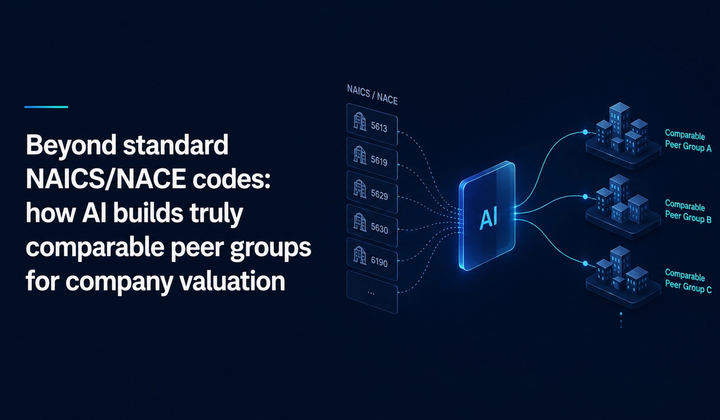
Beyond standard NAICS/NACE codes: how AI builds truly comparable peer groups for company valuation
Classic NAICS/NACE codes lump niche providers into peer groups that don’t fit. See how AI-driven classification builds comparables analysts can confidently defend.

Automated commercial due diligence: how AI helps strategy teams validate market assumptions in hours instead of weeks
Commercial due diligence isn’t slowed down by analysis, but by research. See how AI helps strategy and M&A teams validate markets in hours instead of weeks.